
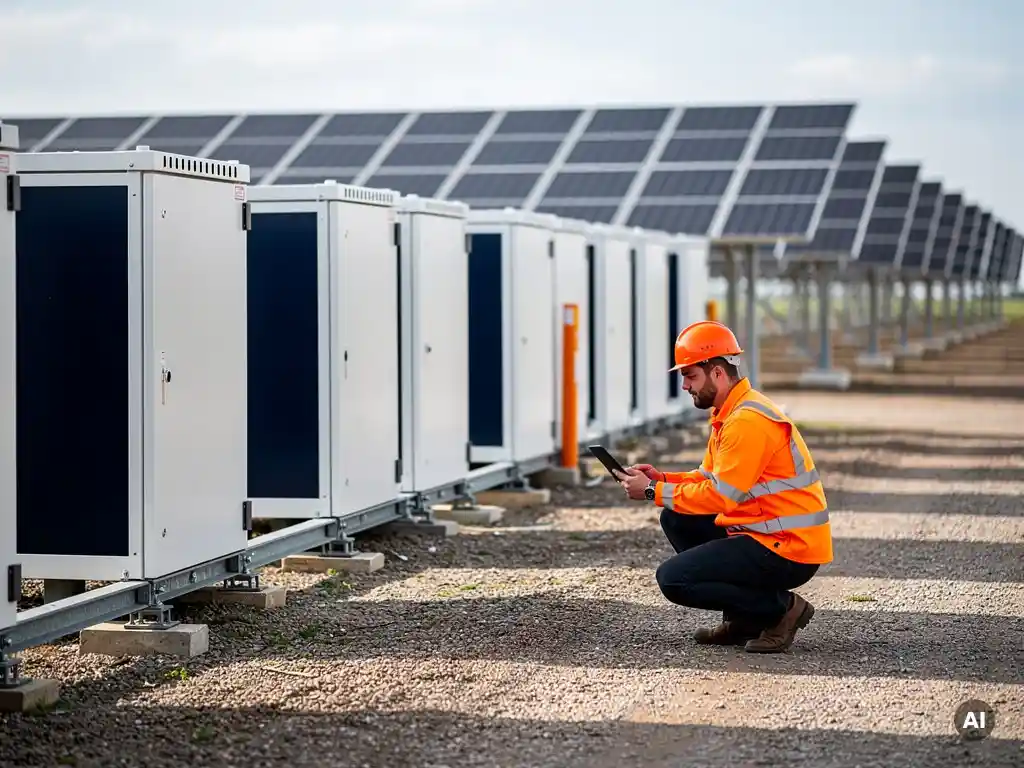

To size a BESS for a commercial solar project, you need to match the system’s energy capacity to your site’s load profile and storage objectives, then select the power capacity to meet your peak discharge requirements. The right size depends on whether you’re targeting self-consumption, peak shaving, backup power, or grid services. The sections below walk through each key sizing question in detail.
What factors determine the right BESS size for a commercial solar project?
The right BESS size for a commercial solar project is determined by your energy objectives, load profile, solar generation curve, grid connection constraints, and budget. No single formula applies universally: sizing is an engineering exercise that balances what the battery needs to do against what the site can economically justify. Getting this wrong in either direction is costly: an undersized system leaves value on the table, while an oversized one destroys the business case.
The most important starting point is defining the primary use case. A BESS designed for peak demand charge reduction needs to be sized around the site’s demand spikes and utility tariff structure. One designed for self-consumption optimization needs to be matched to the gap between solar generation and on-site load during daylight hours. Backup power applications require sizing around critical load duration rather than economics alone.
Beyond the use case, the following factors all feed into the sizing calculation:
- Daily load profile: When does the site consume energy, and how much? A flat load profile is far easier to optimize than a site with sharp morning and evening peaks.
- Solar generation profile: How much excess generation is available to charge the battery, and at what times of day?
- Grid tariff structure: Time-of-use rates, demand charges, and export limitations all directly influence how large a battery needs to be to deliver a return.
- Grid connection capacity: Export limits or import restrictions may constrain how the BESS charges and discharges.
- Depth of discharge and degradation: Usable capacity is always less than nameplate capacity, and batteries degrade over time, so sizing must account for end-of-life performance.
- Regulatory and incentive environment: In 2026, many markets offer incentives tied to minimum BESS capacity thresholds, which can influence sizing decisions.
What is the difference between power capacity and energy capacity in a BESS?
Power capacity (measured in kilowatts or megawatts) is how fast a BESS can charge or discharge energy at any given moment. Energy capacity (measured in kilowatt-hours or megawatt-hours) is how much total energy the system can store and deliver over time. Both specifications are essential, and confusing them is one of the most common mistakes in BESS sizing.
Think of it this way: power capacity determines the rate of flow, energy capacity determines the tank size. A system with high power but low energy can deliver a large burst of electricity for a short time. A system with high energy but low power can sustain a moderate output for many hours. Commercial projects almost always need both specifications to be deliberately matched to the application.
The ratio between energy and power capacity is expressed as the C-rate or, more practically, as the duration. A 500 kW / 1,000 kWh system has a two-hour duration: it can discharge at full power for two hours before the battery is depleted. A 500 kW / 500 kWh system has a one-hour duration. For peak shaving applications, one to two hours of duration is often sufficient. For overnight self-consumption or backup power, four to eight hours may be required.
When evaluating BESS proposals, always confirm both the power and energy ratings, and verify whether the energy figure refers to nameplate capacity or usable capacity after accounting for depth of discharge limits.
How do you calculate the energy capacity needed for a commercial site?
To calculate the energy capacity needed, identify the volume of energy your site needs to shift, store, or protect against grid outages during the target window. Start with your interval meter data, map your solar generation against your load, and quantify the gap you want the battery to fill. That gap, adjusted for round-trip efficiency and depth of discharge, gives you the minimum usable energy capacity required.
Here is a practical step-by-step approach:
- Pull 12 months of 15-minute or 30-minute interval data for both load consumption and, if available, solar generation. Seasonal variation matters significantly for commercial sites.
- Identify your target window. For self-consumption, this is typically the evening hours when solar generation drops but load remains. For peak shaving, it is the daily demand peak window defined by your utility tariff.
- Quantify the energy volume in that window. For example, if your site draws 200 kW for three hours during an evening peak, the raw energy requirement is 600 kWh.
- Adjust for round-trip efficiency. Most lithium-ion BESS systems operate at 85-92% round-trip efficiency. If you need 600 kWh delivered, you need to store roughly 650-700 kWh to account for losses.
- Adjust for depth of discharge. Most systems limit discharge to 80-90% of nameplate capacity to protect battery longevity. Divide your adjusted figure by the usable depth of discharge to get the nameplate capacity required.
- Add a degradation buffer. Batteries lose capacity over their lifetime. Sizing to meet your requirements at year ten rather than year one avoids underperformance later in the project life.
This calculation should be repeated for multiple scenarios: best case, typical, and worst case solar generation months, to ensure the system performs across seasonal variation, not just on an average day.
How does the DC/AC ratio of a solar array affect BESS sizing?
The DC/AC ratio of a solar array affects BESS sizing because it determines how much clipped energy is available to charge the battery. Arrays with a high DC/AC ratio, where the solar panel capacity significantly exceeds the inverter’s AC output limit, regularly produce more energy than the inverter can export. That clipped generation is otherwise wasted, and a BESS can capture it, which directly influences both the charging strategy and the energy capacity required.
In a standard commercial solar design, a DC/AC ratio between 1.1 and 1.3 is common. At these ratios, clipping is modest and the BESS charging profile is primarily shaped by the solar generation curve rather than inverter clipping. However, in projects where the DC/AC ratio is pushed higher, sometimes deliberately to reduce inverter costs or maximize generation during low-irradiance periods, the volume of clipped energy can be substantial, and a BESS sized to capture that energy can meaningfully improve overall system yield.
The DC/AC ratio also interacts with BESS sizing through the inverter’s role in a DC-coupled configuration. In DC-coupled systems, the battery connects before the inverter, meaning the inverter must handle both solar and battery discharge simultaneously. This can require a larger or differently specified inverter, which feeds back into the overall system design. Engineers working through these interactions manually in spreadsheets often find that a change to the DC/AC ratio triggers a cascade of recalculations across the entire design, exactly the kind of repetitive rework that purpose-built solar engineering software is designed to eliminate.
What’s the difference between AC-coupled and DC-coupled BESS configurations?
In an AC-coupled BESS configuration, the battery system connects to the AC side of the solar installation, with its own dedicated bidirectional inverter. In a DC-coupled configuration, the battery connects on the DC side, before the solar inverter, sharing the inverter with the PV array. The choice between them affects system efficiency, cost, flexibility, and how clipped solar energy is handled.
AC-coupled BESS
AC-coupled systems are more flexible because the battery can charge from both the solar array and the grid independently. They are also easier to retrofit onto existing solar installations, since the battery system operates as a standalone unit with its own inverter. The trade-off is efficiency: energy goes through an additional conversion step (DC to AC from the solar panels, then AC to DC into the battery, then DC to AC on discharge), which introduces additional losses compared to DC-coupled systems.
AC coupling is generally preferred for retrofits, larger commercial systems where flexibility and redundancy matter, and sites where grid charging is a meaningful part of the operating strategy.
DC-coupled BESS
DC-coupled systems connect the battery directly to the DC bus, meaning solar energy flows into the battery without an intermediate AC conversion step. This improves round-trip efficiency and makes it easier to capture clipped energy from high DC/AC ratio arrays. The limitation is that DC-coupled systems are more complex to design and are best suited to new-build projects where the entire system can be engineered together from the start.
For commercial projects with aggressive DC/AC ratios and a clear self-consumption or clipping-recovery objective, DC coupling often delivers better overall system performance. For sites prioritizing flexibility or adding storage to an existing installation, AC coupling is typically the more practical choice.
When does adding a BESS to a commercial solar project make financial sense?
Adding a BESS to a commercial solar project makes financial sense when the value it generates, through demand charge reduction, time-of-use arbitrage, export revenue, or backup power avoidance costs, exceeds the total cost of ownership over the system’s lifetime. In 2026, falling battery costs and increasingly favorable tariff structures are making the business case viable for a wider range of commercial sites than ever before.
The strongest financial cases for commercial BESS typically share one or more of these characteristics:
- High demand charges: Sites on tariffs with significant peak demand charges can reduce those charges substantially by discharging the battery during demand peaks. Even a modest reduction in monthly demand charges can generate returns that justify the investment.
- Time-of-use tariff spreads: Where the difference between peak and off-peak electricity rates is large, a BESS can charge during cheap periods and discharge during expensive ones, generating arbitrage value.
- Export limitations: Sites with grid export caps that prevent full solar generation from being exported can use a BESS to store excess generation and deploy it on-site later, improving self-consumption and reducing grid import costs.
- Backup power requirements: For sites where grid outages carry significant operational or financial consequences, the value of backup power may justify BESS costs that would not stack up on energy economics alone.
- Grid services revenue: In markets where commercial BESS can participate in frequency response or other ancillary services markets, additional revenue streams can substantially improve project economics.
The financial case weakens when tariff structures are flat, demand charges are low, or the site already has a high self-consumption ratio without storage. Before committing to a BESS investment, a thorough financial model built on real interval data, not average consumption figures, is essential. If you are working through the engineering and financial analysis for a commercial solar-plus-storage project, speaking with a specialist can help ensure the system is sized and configured to deliver the returns the project needs.
Frequently Asked Questions
How do I account for battery degradation when sizing a BESS for a 10–20 year project life?
Size your BESS to meet your performance requirements at end-of-life, not at commissioning. Most lithium-ion batteries retain around 70–80% of their original capacity after 10 years of typical cycling, so if you need 500 kWh of usable capacity in year ten, you should size the nameplate capacity accordingly from day one. Some projects also address degradation contractually through performance guarantees from the manufacturer, which can reduce the need for an oversized buffer but should be verified carefully against the actual duty cycle the system will perform.
Can a BESS be expanded later if our energy needs grow, or do we need to get the sizing right from the start?
Expandability depends heavily on the system architecture and the specific hardware chosen. Some BESS platforms are modular by design and support capacity additions with relative ease, while others are not practically expandable without significant cost or re-engineering. If future growth is likely, it is worth selecting a platform with a clear expansion pathway from the outset and confirming that the inverter, protection systems, and grid connection can accommodate the additional capacity. Planning for expansion upfront is almost always cheaper than retrofitting it later.
What are the most common sizing mistakes engineers and developers make on commercial BESS projects?
The most frequent mistakes include sizing on average daily consumption rather than interval data (which masks demand peaks and seasonal variation), confusing nameplate capacity with usable capacity, and failing to account for round-trip efficiency losses in the energy balance. Another common error is optimizing for a single use case — such as self-consumption — without checking whether the system also needs to handle backup power or demand charge reduction, which can require a very different power-to-energy ratio. Running the sizing calculation against multiple scenarios, including worst-case solar months and high-load periods, is essential to avoid underperformance in real operating conditions.
How does the choice of battery chemistry affect BESS sizing for commercial solar projects?
Battery chemistry affects sizing primarily through differences in usable depth of discharge, round-trip efficiency, cycle life, and thermal behavior. Lithium iron phosphate (LFP) is currently the dominant chemistry for commercial solar-plus-storage applications due to its strong cycle life, thermal stability, and tolerance for deep discharge, which means a higher proportion of nameplate capacity is practically usable. Other chemistries may offer higher energy density but with trade-offs in longevity or safety that affect how conservatively the system needs to be sized. Always confirm the manufacturer's usable capacity and cycle life figures under the specific duty cycle your project will impose, not just under ideal laboratory conditions.
Do grid connection requirements or utility approval processes affect how a BESS should be sized?
Yes, and this is an area that catches many projects off guard. Utilities in many markets impose export limits, require specific protection relay settings, or restrict the rate at which a BESS can charge from the grid — all of which directly constrain how the system can operate and therefore how it should be sized. In some cases, a larger BESS may trigger a more complex grid connection assessment or require network upgrades that significantly affect project economics. Engaging with the local network operator early in the design process, before finalizing the BESS specification, is strongly recommended to avoid costly redesigns later.
Is there a minimum project size or load profile where adding a BESS to a commercial solar installation typically stops making financial sense?
There is no universal threshold, but the financial case tends to weaken for smaller sites with flat load profiles, low or no demand charges, and minimal time-of-use tariff spreads. As a rough guide, commercial sites consuming less than 200–300 MWh per year with simple flat-rate tariffs often struggle to generate a compelling return on BESS investment based on energy economics alone — though backup power value or specific regulatory incentives can change that calculus. The most reliable way to assess viability is to build a financial model using real 15- or 30-minute interval data and test it against the actual tariff structure, rather than relying on rules of thumb.
How should a BESS be sized if the commercial site plans to participate in grid ancillary services markets in addition to on-site optimization?
Stacking grid services revenue on top of on-site use cases typically requires additional power capacity and careful management of the state of charge, since the battery must hold headroom to respond to grid dispatch signals at any time. This means the system generally needs to be sized larger than on-site optimization alone would dictate, and the control strategy must balance competing priorities dynamically. Before designing for ancillary services participation, confirm that the target market is accessible to commercial-scale assets in your jurisdiction, understand the availability and response requirements, and model the revenue realistically — ancillary services revenues can be significant but are not guaranteed and can change as markets evolve.
Related Articles
- How does battery storage affect DC/AC ratio calculations?
- What is battery storage for solar energy?
- How do you size a BESS for grid support applications?
- What is C-rate in BESS sizing?
- How do you optimize solar layouts for maximum efficiency?
This content was generated with the help of AI — it may contain mistakes