
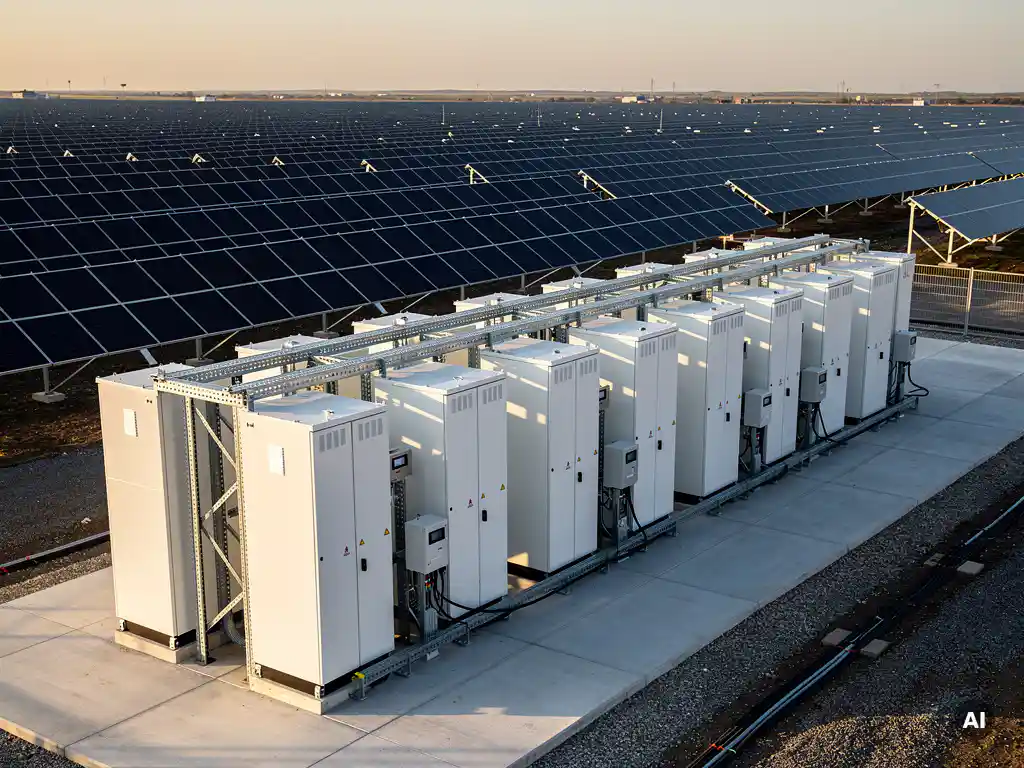

Battery energy storage system (BESS) costs typically range from $150 to $400 per kWh for utility-scale projects, though commercial and industrial systems often sit higher depending on configuration and location. Prices have fallen dramatically over the past decade and continue to decline as manufacturing scales up and technology matures. The sections below break down what drives those numbers, how they compare across storage technologies, and what to budget for beyond the headline kWh figure.
What factors drive BESS cost per kWh?
The cost per kWh of a BESS is shaped by several interacting variables: battery chemistry, system size, duration (how many hours of storage are required), integration complexity, and the balance-of-plant components needed to connect everything together. No two projects land at the same number because each of these factors pulls the final figure in a different direction.
Battery chemistry is the single largest driver. Lithium iron phosphate (LFP) has become the dominant chemistry for stationary storage because it offers a strong balance of cycle life, thermal stability, and cost. Nickel manganese cobalt (NMC) systems can deliver higher energy density but typically carry a cost premium and shorter cycle life. The chemistry you choose sets the floor for your per-kWh price before any other variable enters the equation.
Storage duration matters just as much. A two-hour system and a four-hour system using identical battery cells will have very different per-kWh costs once you factor in the power conversion system (PCS), transformer, and controls, components whose cost is largely fixed regardless of how many kWh of capacity sit behind them. Longer-duration systems spread those fixed costs across more kWh, which generally reduces the per-kWh figure for the storage capacity itself.
Other key cost drivers include:
- Balance of plant: Switchgear, cabling, civil works, and grid interconnection can add significantly to total project cost
- Thermal management: HVAC systems required to keep batteries within operating temperature range
- Battery management system (BMS) and energy management system (EMS): Software and controls that govern safe operation and dispatch
- Supply chain and logistics: Import duties, shipping costs, and local availability of components all affect final pricing
- Site conditions: Ground conditions, grid connection distance, and permitting complexity vary enormously by location
What is the average BESS cost per kWh in 2024-2025?
For utility-scale BESS projects, average all-in costs landed broadly in the range of $200 to $350 per kWh across 2024 and into 2025, with best-in-class projects from experienced developers in competitive markets reaching below $200 per kWh. Commercial and industrial (C&I) systems typically sit higher, often in the $300 to $500 per kWh range, reflecting smaller procurement volumes and higher integration costs relative to capacity.
These figures represent the total installed cost, meaning battery modules, PCS, BMS/EMS, balance of plant, civil works, and installation labor. Battery module prices alone (the cells and packaging) have fallen to levels that would have seemed implausible five years ago, driven by massive manufacturing expansion in Asia and the rapid adoption of LFP chemistry. However, the gap between module cost and total installed cost remains significant, which is why headline battery price announcements from manufacturers do not translate directly into project economics.
Geography plays a meaningful role in where a specific project lands within that range. Projects in markets with streamlined permitting, established supply chains, and competitive EPC markets tend to achieve lower costs. Markets with complex grid interconnection requirements, high labor costs, or limited local competition for EPC services will consistently land at the higher end.
How does BESS cost compare to other energy storage technologies?
Lithium-ion BESS is currently the most cost-competitive technology for two-to-four-hour storage durations, which covers the majority of grid and behind-the-meter applications. Compared to alternatives, it offers the best combination of upfront cost, round-trip efficiency, and proven scalability at this point in time.
Pumped hydro storage
Pumped hydro remains the lowest-cost option on a per-kWh basis for very large, long-duration applications, often cited at $50 to $150 per kWh for the storage capacity itself. However, it requires specific geography (elevation differences and water availability), has very long development timelines, and carries enormous upfront civil engineering costs. It is not a practical option for most commercial or industrial projects.
Flow batteries
Vanadium redox flow batteries and other flow chemistries become increasingly competitive at longer durations (six hours and beyond) because their energy and power components are decoupled: adding more storage capacity means simply adding more electrolyte, not more power hardware. At two-to-four-hour durations, however, flow batteries typically carry a higher per-kWh cost than lithium-ion BESS and are less commercially mature at scale.
Compressed air and gravity storage
Emerging long-duration technologies like compressed air energy storage (CAES) and gravity-based systems are still in early commercial deployment. They show promise for multi-hour and multi-day storage at potentially lower costs, but they are not yet available at the scale or cost point that makes them a direct competitor to lithium-ion BESS for most projects being developed today.
What additional costs should you budget for beyond the kWh price?
The per-kWh figure you see quoted for a BESS rarely captures the full picture. Beyond the battery modules and power conversion system, a realistic project budget must account for grid interconnection, civil and structural works, ongoing operations and maintenance, insurance, and financing costs, all of which can add 30 to 60 percent on top of the equipment price alone.
Key additional cost categories to plan for include:
- Grid interconnection: Transformer upgrades, protection relays, and utility-required studies can range from modest to very significant depending on the point of interconnection and local grid conditions
- Civil works: Foundations, access roads, fencing, drainage, and fire suppression systems are site-specific but rarely trivial
- Operations and maintenance (O&M): Annual O&M costs for a BESS typically run at one to two percent of capital cost per year, covering preventive maintenance, remote monitoring, and component replacement
- Battery augmentation: As cells degrade over time, capacity augmentation may be required mid-life to maintain contracted performance; this is a real lifecycle cost that should appear in financial models
- Insurance: Fire risk associated with lithium-ion batteries means insurance premiums for BESS projects are meaningful and should be modeled explicitly
- Permitting and development costs: Environmental studies, planning applications, and grid connection applications all carry fees and professional service costs
- Financing costs: Interest during construction and the cost of capital significantly affect the levelized cost of storage (LCOS), which is often a more useful metric than upfront per-kWh cost for project economics
How does project scale affect the cost per kWh of a BESS?
Larger BESS projects consistently achieve lower per-kWh costs than smaller ones, primarily because fixed costs, engineering, project management, grid interconnection, and certain balance-of-plant items, are spread across a greater volume of capacity. A 100 MWh project will almost always have a lower per-kWh cost than a 1 MWh project using identical battery technology.
Procurement volume is the other major lever. Utility-scale developers purchasing hundreds of megawatt-hours of battery capacity per year can negotiate meaningfully better pricing from manufacturers than a C&I developer procuring a single system. This volume discount effect compounds over time as developers build track records and long-term supplier relationships.
At the smaller end of the scale, C&I systems in the 100 kWh to 10 MWh range often face a cost premium not just from lower procurement volume but from the relative weight of engineering and commissioning costs. A 500 kWh system requires nearly as much engineering effort as a 2 MWh system, so the per-kWh engineering cost is significantly higher for the smaller project.
This scale dynamic is one reason why aggregation models, where multiple smaller systems are developed and procured together, have gained traction in some markets. By treating a portfolio of C&I systems as a single procurement, developers can access pricing closer to utility-scale economics.
Is BESS cost per kWh expected to fall further?
Yes, the broad consensus among analysts and industry participants is that BESS costs will continue to decline through the remainder of the 2020s, driven by ongoing manufacturing scale-up, chemistry improvements, and increasing supply chain maturity. The pace of decline is expected to moderate compared to the steep reductions seen between 2015 and 2023, but meaningful cost reduction is still anticipated.
The primary driver of further cost reduction is manufacturing capacity. Battery gigafactories continue to come online across Asia, North America, and Europe, increasing supply and intensifying competition among cell manufacturers. As production volumes grow, economies of scale push cell costs lower, and since cells represent the largest single cost component in a BESS, this flows directly into system-level pricing.
Chemistry evolution is another factor. LFP has already displaced NMC as the dominant stationary storage chemistry largely on cost grounds, and further refinements to cell design, energy density, and cycle life continue to improve the value delivered per kWh of installed capacity. Sodium-ion batteries are also emerging as a potential lower-cost alternative for some applications, though they are not yet commercially deployed at scale for stationary storage.
Soft costs, engineering, permitting, interconnection, and financing, are also expected to fall as the industry standardizes processes and regulators develop clearer frameworks for BESS projects. These costs have historically been slower to decline than hardware costs, but growing market experience is beginning to drive efficiency improvements here too.
For solar-plus-storage projects specifically, the integration of BESS with PV systems adds another layer of engineering complexity that benefits from purpose-built design tools. If you are working on projects that combine solar generation with battery storage, Virto Solar’s design software can help streamline the engineering workflow from layout through to construction-ready documentation. For project-specific guidance, you are also welcome to get in touch with our team to discuss your requirements.
Frequently Asked Questions
How do I compare BESS quotes from different vendors on a like-for-like basis?
Always ask vendors to provide an all-in installed cost figure that includes battery modules, PCS, BMS/EMS, balance of plant, civil works, and commissioning — not just the battery module price. Request a detailed cost breakdown so you can identify what is and isn't included, and normalize quotes to the same usable capacity (not nameplate) and the same duration. Differences in warranty terms, cycle life guarantees, and augmentation provisions can also significantly affect the true cost of ownership, so these should be part of any apples-to-apples comparison.
What is the difference between cost per kWh and levelized cost of storage (LCOS), and which should I use?
Cost per kWh is an upfront capital metric that tells you what you pay to install a given amount of storage capacity, while levelized cost of storage (LCOS) accounts for the full lifecycle cost — capital, O&M, augmentation, financing, and insurance — divided by the total energy discharged over the system's lifetime. For investment decisions and revenue modeling, LCOS is almost always the more useful metric because it captures how efficiently the system delivers energy over time. A system with a lower upfront cost per kWh but shorter cycle life or higher O&M costs can easily have a worse LCOS than a more expensive but longer-lasting alternative.
What cycle life and warranty terms should I expect from a utility-scale LFP BESS?
Leading LFP BESS products typically offer warranties covering 4,000 to 6,000 cycles or 10 to 15 years of operation, with end-of-warranty capacity retention guarantees commonly set at 70 to 80 percent of nameplate capacity. For projects that cycle daily, this translates to roughly 10 to 15 years of warranted life, which should align with your project's financing term. Pay close attention to the conditions attached to the warranty — cycle depth, operating temperature range, and charge/discharge rate limits — as exceeding these can void coverage and expose you to unplanned augmentation costs.
What are the most common mistakes developers make when budgeting for a BESS project?
The most frequent mistake is anchoring the budget to battery module prices rather than total installed cost, which routinely leads to significant underestimation of project costs. Developers also commonly underbudget for grid interconnection (which can be highly variable and difficult to estimate early in development) and omit lifecycle costs like augmentation and insurance from their financial models entirely. Building in a contingency of 10 to 15 percent on top of your all-in cost estimate is a practical safeguard, particularly for first-of-kind sites or markets where EPC competition is limited.
How does storage duration affect which battery technology makes the most economic sense?
For durations of two to four hours, lithium-ion LFP BESS is currently the most cost-competitive and commercially proven option for the vast majority of projects. As duration extends beyond six hours, flow batteries and emerging long-duration technologies become increasingly attractive because their architecture allows energy capacity to be scaled independently of power capacity — meaning the cost per additional kWh of storage drops significantly. If your project requires eight or more hours of storage, it is worth running a technology comparison that includes flow batteries, even if lithium-ion still wins on cost today, because the economics are converging and project timelines may extend into a period where alternatives are more competitive.
Are there financing structures or incentives that can meaningfully reduce the effective cost of a BESS project?
Yes — in many markets, BESS projects can access investment tax credits, accelerated depreciation, or direct grants that can reduce the effective capital cost by 20 to 40 percent depending on jurisdiction. In the United States, the Inflation Reduction Act's Investment Tax Credit (ITC) applies to standalone storage projects, which has significantly improved project economics since 2023. Beyond incentives, project finance structures such as non-recourse debt, sale-leaseback arrangements, and power purchase agreements (PPAs) with storage components can reduce the equity required upfront and improve returns, making projects viable at cost points that would otherwise be marginal.
How should I think about battery augmentation costs when modeling a long-term BESS project?
Augmentation — adding new battery cells mid-life to restore degraded capacity — is a real and often underestimated lifecycle cost that should be explicitly modeled in any project financial analysis covering more than 10 years. A common approach is to budget for one augmentation event at roughly the halfway point of the project's contracted life, using a cost assumption that reflects expected future battery prices (which are generally projected to be lower than today's). Working with your BESS supplier to include augmentation provisions in the original supply agreement, including pricing caps or options on future cell purchases, can provide meaningful cost certainty and protect against supply chain disruptions later in the project's life.
Related Articles
- What is a three-line diagram vs a single line diagram?
- How do you size battery storage for a solar carport project?
- What safety codes apply to battery storage wiring?
- How do you size cables using a solar wiring diagram?
- What is battery storage for solar energy?
This content was generated with the help of AI — it may contain mistakes