
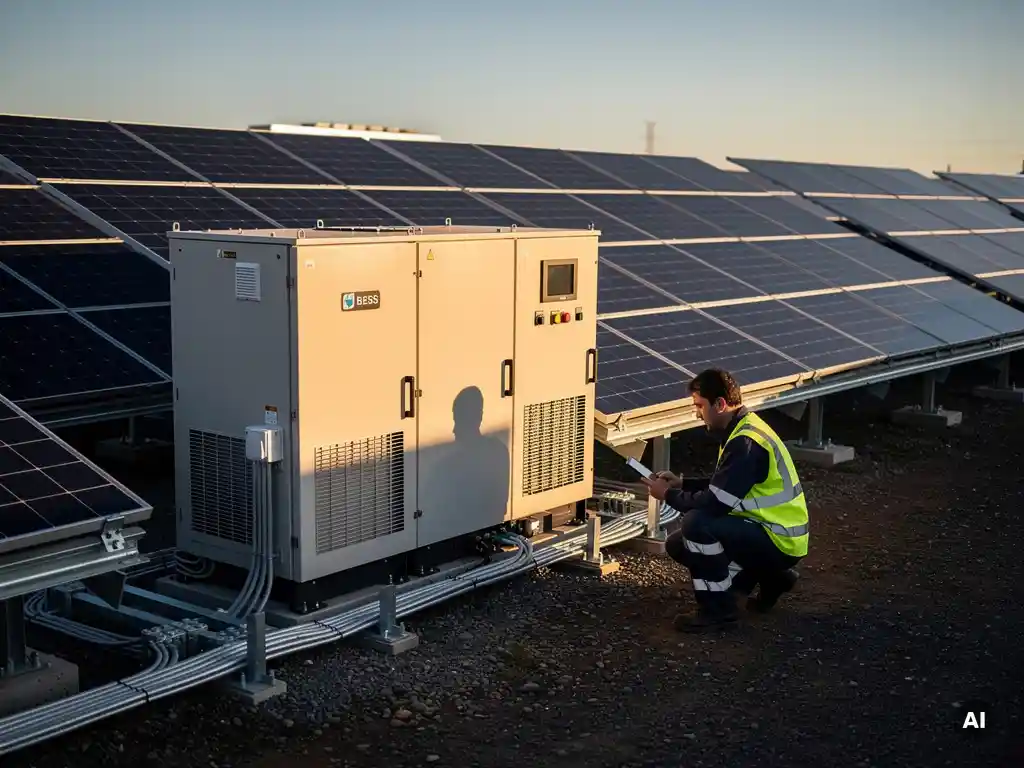

To size a battery for a solar system, multiply your daily energy consumption (in kilowatt-hours) by the number of days of backup you want, then divide by the battery’s usable depth of discharge. The result gives you the minimum storage capacity you need. Battery chemistry, system voltage, and load profile all influence the final sizing decision.
Getting the sizing right matters more than most people expect. An undersized battery leaves you without power when you need it most, while an oversized one wastes capital that could go toward additional panels or system optimization. The sections below walk through each key question in the sizing process, from calculating your energy needs to understanding what can cause a well-sized battery to still fall short.
How much energy do you actually need to store?
The starting point for battery sizing is your actual daily energy consumption, measured in kilowatt-hours (kWh). Add up the wattage of every load you want the battery to support, multiply each by the hours it runs per day, and sum the results. This gives you your daily load in watt-hours, which you then convert to kWh by dividing by 1,000.
For a commercial or industrial site, this calculation becomes more involved. You need to distinguish between critical loads (the equipment that must stay on during a grid outage or low-generation period) and non-critical loads that can be shed. Sizing a battery around your entire facility’s consumption is rarely practical or cost-effective. Sizing it around your critical load profile is the more disciplined engineering approach.
It is also worth accounting for system inefficiencies at this stage. Inverter losses, wiring losses, and temperature-related derating mean that the energy leaving your battery is always somewhat less than what went in. A round-trip efficiency factor of around 90 to 95 percent is typical for modern lithium-ion systems, so factor that into your target storage capacity rather than discovering the shortfall after installation.
What is depth of discharge and why does it affect battery size?
Depth of discharge (DoD) is the percentage of a battery’s total capacity that can be safely used before it needs recharging. A battery with a 100 kWh nominal capacity and an 80% DoD has 80 kWh of usable energy. Exceeding the recommended DoD shortens battery lifespan significantly, so DoD is a hard constraint in any sizing calculation, not a guideline to approximate.
Different battery chemistries carry very different DoD ratings. Lithium iron phosphate (LFP) batteries typically support 80 to 100 percent DoD, which is one reason they have become the dominant choice for solar storage in commercial applications. Lead-acid batteries, by contrast, are generally limited to 50 percent DoD to preserve cycle life. This means a lead-acid battery must be twice the nominal size of a lithium battery to deliver the same usable capacity.
When sizing, always work from usable capacity rather than nominal capacity. If your daily load calculation shows you need 40 kWh of storage and you are using a lithium battery with 90% DoD, your minimum nominal capacity is approximately 44.5 kWh. If you were using a lead-acid battery at 50% DoD, you would need a nominal capacity of 80 kWh to deliver the same usable energy. This distinction alone can dramatically change both the physical footprint and the cost of your storage system.
How do you calculate the number of batteries you need?
To calculate the number of batteries required, divide your total required usable storage capacity by the usable capacity of a single battery unit. Usable capacity per unit equals the battery’s nominal capacity multiplied by its rated DoD. Round up to the nearest whole number, since you cannot install a fraction of a battery.
Here is a straightforward example. Suppose your critical daily load is 30 kWh and you want two days of autonomy. Your total required storage is 60 kWh. You are using lithium batteries with a nominal capacity of 10 kWh each and a DoD of 90%, giving 9 kWh of usable energy per unit. Dividing 60 kWh by 9 kWh gives 6.67, which rounds up to 7 batteries.
Beyond raw count, you also need to consider how batteries are wired together. Series connections increase system voltage while parallel connections increase capacity. Your battery bank configuration must match your inverter’s input voltage requirements, so the electrical design and the capacity calculation need to be done together rather than in isolation. String sizing errors at this stage can result in systems that are correctly sized on paper but incompatible with the inverter in practice.
What’s the difference between lithium-ion and lead-acid for solar storage?
The key difference between lithium-ion and lead-acid batteries for solar storage is usable capacity relative to physical size and weight. Lithium-ion batteries offer higher energy density, deeper discharge, longer cycle life, and faster charge acceptance. Lead-acid batteries cost less upfront but require more space, more maintenance, and more nominal capacity to deliver the same usable energy over the system’s lifetime.
Lithium-ion batteries
Lithium-ion batteries, particularly lithium iron phosphate (LFP) chemistry, have become the standard for commercial and utility-scale solar storage. They support 80 to 100 percent DoD, deliver 2,000 to 6,000 or more cycles depending on the manufacturer, and require virtually no maintenance. Their higher upfront cost is typically offset by a lower cost per usable kWh over the system’s lifetime, especially when you account for the fact that a lithium battery sized for a given load will be physically smaller and lighter than its lead-acid equivalent.
Lead-acid batteries
Lead-acid batteries remain relevant in off-grid applications where upfront cost is the primary constraint and the system owner is comfortable with regular maintenance. Flooded lead-acid batteries require periodic water top-ups and ventilation to manage hydrogen off-gassing. Sealed AGM and gel variants reduce maintenance demands but still carry the 50 percent DoD limitation. For any project where long-term reliability and space efficiency matter, lithium-ion is the more defensible engineering choice.
How many days of autonomy should a solar battery system provide?
The number of days of autonomy a solar battery system should provide depends on the application and the local solar resource. For grid-tied commercial systems, one to two days of autonomy for critical loads is a common design target. For off-grid systems in regions with extended low-irradiance periods, three to five days may be necessary to bridge consecutive cloudy days without generator backup.
Autonomy requirements are not purely a technical question. They are also a risk-tolerance and cost question. Every additional day of autonomy adds directly to battery capacity requirements and therefore to system cost. The engineering discipline here is to model the worst-case consecutive low-generation days for the specific site location, then size autonomy to cover that scenario rather than an arbitrary round number.
For grid-tied systems with net metering or time-of-use tariff optimization, the autonomy framing shifts somewhat. The battery is not primarily a backup device but a dispatch asset. In that context, sizing is driven by the energy arbitrage window (typically one to two days at most) rather than extended outage scenarios. Understanding which use case applies to your project is the first step before any autonomy calculation begins.
What factors can cause a correctly sized battery to underperform?
A correctly sized battery can underperform due to temperature effects, state-of-charge management errors, inverter compatibility issues, or loads that exceed the original design assumptions. Each of these factors reduces effective capacity or accelerates degradation, meaning the system delivers less usable energy than the sizing calculation predicted.
Temperature is one of the most commonly underestimated variables. Battery capacity decreases in cold conditions and degrades faster in sustained heat. A battery rated at 100 kWh at 25 degrees Celsius may deliver noticeably less at 5 degrees. If the battery enclosure is not thermally managed, real-world performance in climates with cold winters or hot summers will consistently fall short of nameplate specifications.
Inverter and battery compatibility is another frequent source of underperformance. If the inverter’s charge controller settings do not match the battery manufacturer’s recommended charge voltage and current limits, the battery may never reach full state of charge, effectively reducing usable capacity from day one. This is a commissioning issue as much as a design issue, but it originates in the specification stage when battery and inverter are selected without verifying compatibility.
Finally, load growth is a structural risk that no sizing calculation can fully anticipate. A system sized for today’s critical loads may be undersized within two or three years if the facility expands or adds new equipment. Building in a modest capacity buffer, or at minimum designing the battery bank to be expandable, is a practical way to protect the investment against future demand growth.
If you are working through battery sizing as part of a broader PV system design and want to see how engineering software can streamline the process, try Virto Solar’s tools to explore how automated design workflows reduce manual calculation time. For project-specific guidance, you are also welcome to get in touch with our team directly.
Frequently Asked Questions
How do I account for battery degradation over time in my sizing calculation?
Battery capacity degrades with each charge-discharge cycle, meaning a battery that delivers 100% of its rated capacity at installation may deliver only 80% after several years of use. To future-proof your sizing, it is good practice to add a degradation buffer of 10–20% to your initial capacity calculation, or to verify that the manufacturer's end-of-life capacity guarantee (typically 70–80% of nominal) still meets your minimum load requirements. Reviewing the manufacturer's cycle-life curve at your expected daily DoD gives you the most accurate picture of how capacity will decline over the system's operational lifespan.
Can I mix different battery types or capacities in the same battery bank?
Mixing different battery chemistries, ages, or capacities in the same bank is strongly discouraged and can cause serious performance and safety issues. Batteries with different internal resistances or voltage characteristics will charge and discharge unevenly, accelerating degradation in the weaker units and potentially causing overcharging or thermal events. If you need to expand an existing battery bank, the safest approach is to add identical units from the same manufacturer and production batch, or to design the system from the outset with modular expansion in mind.
What is the right way to size the solar array relative to the battery bank?
As a general rule, your solar array should be capable of fully recharging your battery bank within one to two days of average solar irradiance for your location, ensuring the system can recover quickly after a period of high discharge. A common starting benchmark is a charge-to-storage ratio of 0.1C to 0.2C, meaning a 100 kWh battery bank should receive 10–20 kW of charging input. However, the precise ratio depends on your autonomy requirements, local solar resource data, and whether a generator or grid connection serves as a backup charging source.
What happens if my actual daily energy consumption turns out to be higher than my original estimate?
If real-world consumption exceeds your design assumptions, the battery will cycle deeper than intended, reducing its effective lifespan and leaving you short of power during peak demand or low-generation periods. The best mitigation is to revisit your load audit using actual utility bills or submetered data rather than estimated appliance runtimes, and to build a 10–20% safety margin into your storage target before finalizing the design. If the system is already installed, adding load management controls or shedding non-critical loads during discharge periods can help bridge the gap without immediately requiring additional battery capacity.
Do I need a battery management system (BMS), and is it included with commercial batteries?
A battery management system (BMS) is essential for any lithium-based storage installation — it monitors cell voltages, temperatures, and state of charge, and protects the battery from overcharging, deep discharge, and thermal runaway. Most commercial lithium battery products, particularly rack-mounted LFP systems, include an integrated BMS as standard. However, you should always verify that the BMS communicates with your chosen inverter using a compatible protocol (such as CAN bus or RS485/Modbus), since a BMS that cannot exchange data with the inverter limits the system's ability to optimize charging and discharging behavior.
Is it worth oversizing the battery bank to allow for future load growth?
Building in a modest capacity buffer of 15–25% above your current calculated requirement is generally a sound investment, particularly for commercial sites where energy demand tends to grow over time. The incremental cost of slightly oversizing at the design stage is almost always lower than retrofitting additional capacity later, which may require new wiring, updated inverter configurations, or structural changes to the installation space. At minimum, even if you do not install extra capacity upfront, designing the battery bank architecture to be expandable — with space, conduit, and electrical headroom for additional units — keeps future upgrades straightforward and cost-effective.
What permits or standards apply to commercial solar battery installations?
Commercial battery storage installations are subject to electrical codes, fire codes, and building permits that vary by jurisdiction, but common reference standards include the NEC (NFPA 70) in the United States, IEC 62619 for battery safety, and UL 9540 for energy storage systems. Fire authorities increasingly require compliance with NFPA 855, which governs the maximum allowable battery capacity per fire compartment and mandates specific separation distances and suppression systems. Engaging a licensed electrical engineer and coordinating with your local authority having jurisdiction (AHJ) early in the design process is the most reliable way to ensure your system meets all applicable requirements before installation begins.
Related Articles
- How do you engineer battery storage for ground-mount solar plants?
- How does battery storage affect DC/AC ratio calculations?
- What is the difference between residential and commercial battery storage?
- How do you show inverter connections in a solar wiring diagram?
- How do you size a BESS for grid support applications?
This content was generated with the help of AI — it may contain mistakes