
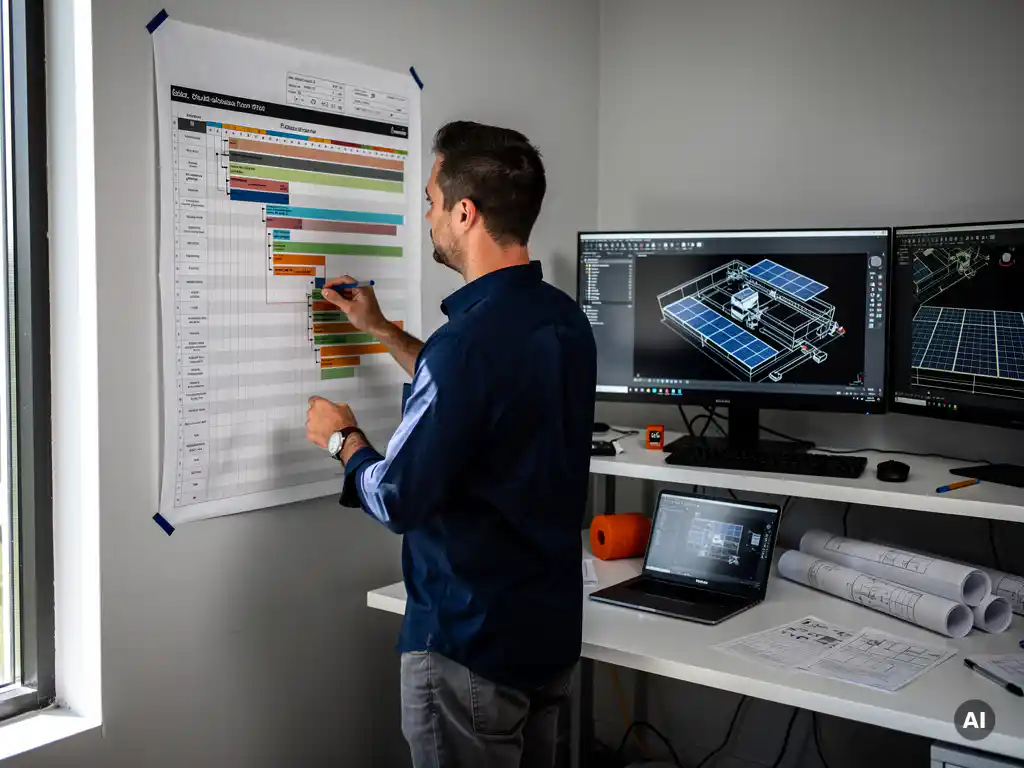

Designing a BESS (Battery Energy Storage System) typically takes anywhere from a few weeks to several months, depending on project scale and complexity. A small commercial BESS project might be scoped and engineered in two to four weeks, while a utility-scale system with grid interconnection requirements can take three to six months or more. The sections below break down exactly what drives that timeline and where the biggest delays tend to occur.
What factors determine how long a BESS design takes?
The duration of a BESS design project is primarily determined by system scale, site conditions, grid interconnection complexity, and the depth of engineering documentation required. These four variables interact with each other, meaning a large project with complex grid requirements and poor site data can take dramatically longer than a similarly sized project with clean inputs and a straightforward connection point.
Here are the key factors that shape the overall design timeline:
- System capacity and topology: Larger systems require more detailed single-line diagrams, more complex protection coordination studies, and more extensive thermal and electrical calculations.
- Grid interconnection requirements: Utility interconnection studies, power quality assessments, and protection relay settings can add weeks or months to the process, often outside the engineering team’s control.
- Site data quality: Accurate topographical surveys, geotechnical reports, and existing infrastructure data significantly reduce rework. Missing or unreliable site data is one of the most common sources of design delays.
- Technology selection: The choice of battery chemistry, inverter type (AC-coupled vs. DC-coupled), and enclosure configuration all influence how much custom engineering is required.
- Permitting and regulatory environment: Local fire codes, building regulations, and environmental assessments vary widely and can add unpredictable lead time.
- Stakeholder review cycles: The number of internal and external review rounds, especially on utility-scale projects, often adds as much time as the engineering itself.
What are the main engineering phases of a BESS design?
A BESS design project typically moves through four main engineering phases: conceptual design, preliminary engineering, detailed engineering, and construction documentation. Each phase builds on the previous one, and skipping or rushing any phase tends to create costly rework downstream.
Conceptual design
This phase defines the system’s purpose, capacity, and high-level architecture. Engineers assess the energy use case (peak shaving, frequency regulation, backup power, etc.), size the battery and inverter capacity, and identify the grid connection point. This phase usually takes one to two weeks for commercial projects and two to four weeks for utility-scale systems.
Preliminary engineering
Preliminary engineering translates the concept into a technical framework. This includes initial single-line diagrams, equipment selection, site layout concepts, and a first pass at protection coordination. Interconnection applications are typically submitted at this stage, which is where external timelines begin to influence the overall schedule.
Detailed engineering
This is the most time-intensive phase. Engineers produce construction-ready drawings, cable sizing calculations, protection relay settings, thermal management specifications, and full bills of materials. For a mid-size commercial BESS, this phase alone can take two to four weeks. For utility-scale projects, it often runs two to three months.
Construction documentation and review
The final phase packages all engineering outputs into permit-ready and contractor-ready documentation. This includes as-built drawing templates, commissioning plans, and safety documentation. Review cycles with the client, utility, and authority having jurisdiction (AHJ) are factored in here and can extend the phase significantly depending on the number of revision rounds required.
How long does BESS design take compared to a standard PV project?
BESS design generally takes longer than a comparable PV-only project, often by a factor of 1.5 to 2 times, because it introduces additional engineering disciplines that a standard solar design does not require. While a commercial rooftop PV system might be fully engineered in one to two weeks, an equivalent BESS addition to that same project can add another two to four weeks of engineering effort.
The key reasons BESS design is more complex than PV design include:
- Protection coordination: BESS systems require detailed protection relay studies to ensure safe grid interaction, which PV-only projects rarely need at the same depth.
- Thermal and fire safety engineering: Battery enclosures require thermal management design and fire suppression planning, both of which are absent from standard PV work.
- Control and communication systems: BESS projects involve energy management system (EMS) configuration and SCADA integration, adding a software and controls engineering layer.
- Utility coordination: Grid-scale storage often triggers more rigorous interconnection studies than a PV-only project of the same capacity.
That said, when BESS is designed as part of a hybrid PV-plus-storage project from the outset, some engineering phases overlap and the combined timeline is shorter than designing each system independently.
What causes delays in BESS system design projects?
The most common causes of BESS design delays are interconnection study timelines, incomplete site data, late equipment specifications, and iterative stakeholder review cycles. Of these, interconnection studies are the most disruptive because they are driven by utility schedules that engineering teams cannot control.
Beyond interconnection, several internal factors consistently slow projects down:
- Late or changing equipment data: When battery or inverter specifications change mid-design, downstream calculations must be redone. This is the BESS equivalent of a module swap in PV design, and it can trigger hours or days of rework across multiple documents.
- Manual calculation workflows: Teams relying on spreadsheets for cable sizing, protection coordination, and BOM generation face compounding errors and slow revision cycles. Each design change requires manual updates across multiple files.
- Siloed engineering teams: When electrical, civil, and controls engineers work in separate tools without shared data, coordination gaps emerge that only surface during final review, requiring significant rework.
- Permitting uncertainty: Fire codes and building regulations for BESS installations vary significantly between jurisdictions and are still evolving in many regions as of 2026. Navigating this uncertainty adds unpredictable lead time.
- Insufficient front-end engineering: Rushing the conceptual phase to save time often results in fundamental design changes during detailed engineering, which costs far more time than the initial shortcut saved.
Can software reduce BESS design time significantly?
Yes, the right software can meaningfully reduce BESS design time by automating repetitive calculations, eliminating manual data re-entry between design phases, and generating construction-ready documentation directly from engineering inputs. The gains are most significant in the detailed engineering phase, where manual workflows consume the most time.
For the PV side of hybrid BESS-plus-solar projects, tools like Virto Solar’s design platform demonstrate how automation transforms engineering timelines. By automating string configuration, cable sizing, shading analysis, single-line diagram generation, and BOM production within the CAD environment engineers already use, we help teams cut PV design time by up to 80%. That same principle applies to BESS integration workflows: when calculations are automated and linked to a live design model, a change in battery capacity or inverter selection propagates through the documentation automatically rather than triggering hours of manual updates.
The categories of software that reduce BESS design time most effectively include:
- Integrated CAD tools: Plugins that automate single-line diagram generation and electrical calculations within AutoCAD or BricsCAD eliminate the manual drawing work that consumes detailed engineering time.
- Protection coordination software: Dedicated tools for relay settings and fault current analysis replace time-intensive manual calculations.
- EMS and SCADA configuration platforms: Pre-built templates and configuration tools reduce the controls engineering effort significantly.
- Collaborative design platforms: Cloud-based tools that allow electrical, civil, and controls teams to work from a shared data model reduce coordination errors and review cycles.
If your team is spending weeks on engineering tasks that should take days, it is worth exploring where automation can close that gap. Reach out to our team to discuss how integrated design tools can fit into your existing workflow.
Frequently Asked Questions
How do I know whether my BESS project needs a full utility interconnection study or a simplified review?
This depends on your system's capacity, point of interconnection, and your utility's specific thresholds. Most utilities apply a simplified or expedited review process for smaller systems (often below 1–5 MW, though thresholds vary by region), while larger systems trigger full interconnection studies that can take months. The best first step is to contact your utility's interconnection department early in the conceptual phase and request their current study queue timelines and capacity thresholds before finalizing your design schedule.
What site data should I collect before starting BESS design to avoid delays later?
At a minimum, you should have a topographical survey, geotechnical report, existing electrical infrastructure drawings (including the point of common coupling details), utility rate schedules, and any available load data before detailed engineering begins. Missing geotechnical data is a particularly common culprit for delays, since it affects foundation design, civil layout, and equipment pad specifications. Investing in thorough front-end data collection almost always saves more time than it costs.
Can I run BESS design phases in parallel to compress the overall timeline?
Yes, some phases can be overlapped strategically, but doing so carries risk if upstream decisions are not yet finalized. For example, preliminary civil design can proceed in parallel with electrical single-line development, but detailed cable sizing should not begin until equipment selections are locked. The most effective compression strategy is to front-load decision-making — locking in battery chemistry, inverter type, and grid connection point as early as possible — so that downstream phases can run with minimal rework risk.
What are the most common mistakes engineers make that extend BESS design timelines?
The three most frequent mistakes are starting detailed engineering before equipment specifications are confirmed, underestimating the time required for protection coordination studies, and treating interconnection applications as a late-stage task rather than submitting them at the preliminary engineering phase. A fourth common mistake is relying on disconnected spreadsheets for calculations, which means any design change must be manually propagated across multiple documents — a process that compounds errors and consumes revision time that integrated tools would eliminate entirely.
How does battery chemistry choice (e.g., LFP vs. NMC) affect the design timeline?
Battery chemistry affects design timeline primarily through its influence on thermal management requirements, fire suppression system design, and the depth of safety documentation needed. LFP (lithium iron phosphate) chemistry, which is now dominant in stationary storage, has a more favorable thermal runaway profile than NMC, which can simplify fire safety engineering and reduce the complexity of AHJ review. Switching chemistries mid-design, however, can trigger significant rework across thermal, structural, and protection calculations, so locking in chemistry selection early is critical to keeping the schedule on track.
At what project size does it make sense to invest in dedicated BESS design software rather than using general-purpose tools?
For most engineering teams, the break-even point is reached fairly quickly — even on mid-size commercial projects in the 500 kW to 2 MW range, the time saved in automated cable sizing, BOM generation, and single-line diagram updates typically offsets the tooling investment within the first few projects. For teams handling multiple BESS projects per year or working on utility-scale systems, the ROI is substantially higher, since the detailed engineering phase alone can represent weeks of manual effort that integrated tools reduce to days.
How should I structure the stakeholder review process to avoid it becoming a major source of delay?
The most effective approach is to define a fixed number of review rounds, assign clear deadlines for feedback, and consolidate comments from all stakeholders into a single marked-up document rather than managing parallel feedback streams. Issuing interim design packages at the end of each engineering phase — rather than waiting for a single final submission — also reduces the volume and severity of late-stage comments. Setting expectations upfront about what constitutes a scope change versus a standard revision will further protect your schedule from open-ended review cycles.
Related Articles
- How does battery storage support utility-scale solar projects?
- What is behind-the-meter battery storage?
- How do you size a battery for a solar system?
- What are the benefits of using PV design software?
- How do you validate solar system performance before construction?
This content was generated with the help of AI — it may contain mistakes