
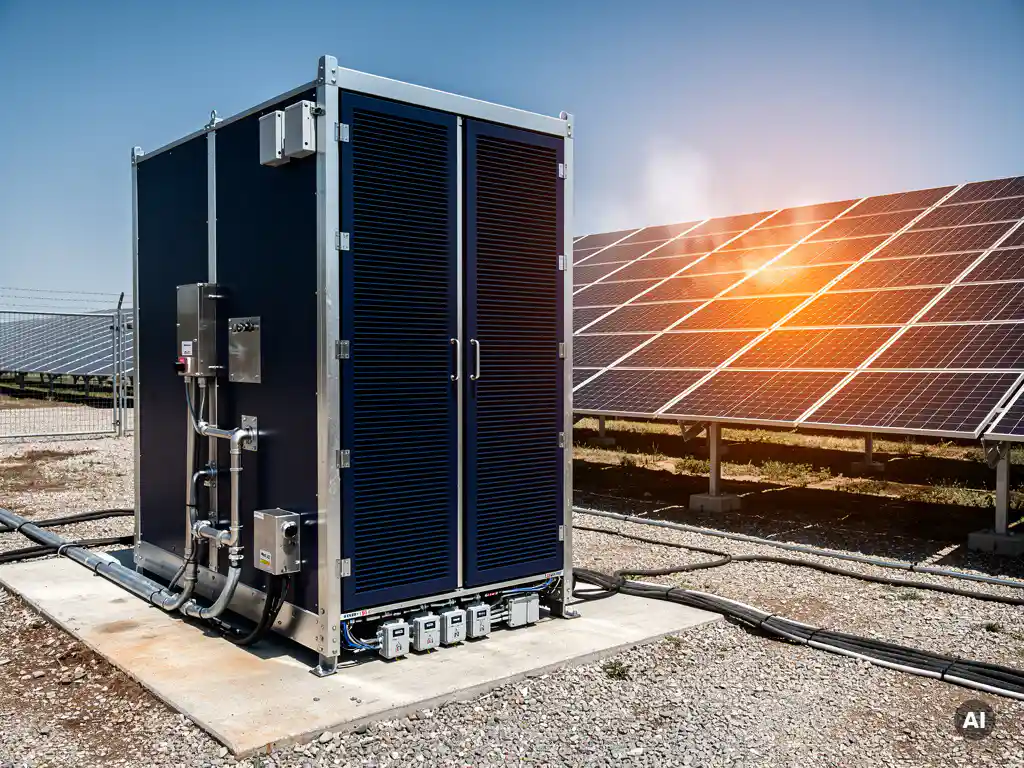

BESS thermal management is the set of systems and strategies used to monitor, regulate, and maintain safe operating temperatures within a battery energy storage system. Without it, batteries degrade faster, perform inconsistently, and in worst-case scenarios, become a serious safety hazard. This article walks through the key questions engineers and project developers ask about BESS thermal management, from performance impacts to cooling technologies and regulatory standards.
How does thermal management affect BESS performance and lifespan?
Thermal management directly determines how efficiently a BESS operates and how long its battery cells last. Lithium-ion cells, which dominate modern BESS installations, perform best within a narrow temperature window, typically between 15°C and 35°C. Operating consistently outside this range accelerates capacity fade, increases internal resistance, and shortens the usable life of the system.
Heat is the primary enemy of battery longevity. When cells run too hot, the chemical reactions inside them become unstable, degrading the electrode materials and electrolyte over time. This means a system that regularly operates at elevated temperatures may lose a significant portion of its rated capacity well before its expected end-of-life date, creating financial risk for project owners and developers.
Cold temperatures present a different but equally serious problem. At low temperatures, lithium-ion cells experience reduced ion mobility, which limits charge acceptance and discharge power. Charging a cold battery too aggressively can cause lithium plating on the anode, a form of irreversible damage that permanently reduces capacity and raises safety concerns.
Effective thermal management keeps cells within their optimal range under all operating conditions, whether the system is charging, discharging, or sitting idle in extreme ambient temperatures. The result is more predictable performance, longer cycle life, and better return on investment over the project lifetime.
What are the main types of BESS thermal management systems?
The main types of BESS thermal management systems are air cooling, liquid cooling, phase-change material (PCM) cooling, and refrigerant-based cooling. Each approach balances cost, complexity, and thermal performance differently, and the right choice depends on system size, duty cycle, and deployment environment.
Air cooling
Air cooling uses fans or HVAC systems to circulate air across battery modules, removing heat through convection. It is the simplest and lowest-cost approach, making it common in smaller or less demanding installations. The main limitation is that air has relatively low thermal conductivity, which makes it less effective at managing heat in high-power or high-density systems where cells generate significant heat during rapid charge and discharge cycles.
Liquid cooling
Liquid cooling circulates a coolant, typically water-glycol, through channels or cold plates in direct contact with battery modules. Because liquid transfers heat far more efficiently than air, this approach is better suited to large-scale or high-cycle BESS installations where precise temperature control is critical. Liquid cooling adds mechanical complexity and requires more maintenance, but it delivers tighter temperature uniformity across the battery pack, which is important for cell balancing and long-term performance.
Phase-change materials and refrigerant systems
PCM cooling uses materials that absorb heat as they transition from solid to liquid, providing passive thermal buffering without active mechanical systems. Refrigerant-based cooling, similar in principle to a heat pump, offers high cooling capacity and is increasingly used in utility-scale BESS containers deployed in hot climates. Both approaches are more specialized and typically reserved for applications where standard air or liquid cooling cannot meet the thermal demands.
What causes thermal runaway in battery energy storage systems?
Thermal runaway in a BESS occurs when a battery cell generates heat faster than it can dissipate it, triggering a self-reinforcing cycle of rising temperature and accelerating chemical reactions that can lead to fire or explosion. It is one of the most serious safety risks in battery energy storage and a primary reason thermal management is treated as a critical engineering requirement.
The most common triggers for thermal runaway include overcharging, external short circuits, mechanical damage to cells, manufacturing defects, and prolonged operation at elevated temperatures. When a cell enters thermal runaway, it can release flammable gases and propagate the reaction to neighboring cells, a process known as cell-to-cell propagation, which can rapidly escalate into a system-level event.
Preventing thermal runaway requires a layered approach. Thermal management systems keep cells within safe temperature limits during normal operation. Battery management systems monitor voltage, current, and temperature at the cell level to detect early warning signs. Physical separation, fire-resistant materials, and venting designs limit propagation if a single cell does fail. Together, these layers form the safety architecture that responsible BESS design depends on.
How does a battery management system (BMS) control BESS temperature?
A battery management system controls BESS temperature by continuously monitoring cell-level temperature sensors and triggering cooling, heating, or power-limiting responses to keep the system within safe operating bounds. The BMS acts as the intelligence layer that translates raw sensor data into real-time thermal control decisions.
In practice, a BMS monitors temperature at multiple points across the battery pack, not just at a single location. Temperature gradients between cells are as important as absolute temperature values, because uneven heat distribution causes cells to age at different rates, reducing overall pack performance. When the BMS detects a cell or module approaching a threshold, it can activate cooling fans or pumps, reduce charge or discharge current, or in extreme cases, disconnect the system entirely to prevent damage.
Modern BMS platforms also incorporate predictive logic. Rather than reacting only when a threshold is breached, they use historical operating data and ambient temperature inputs to anticipate thermal stress and adjust system behavior proactively. This is particularly valuable in utility-scale BESS installations where the cost of an unplanned shutdown or accelerated degradation is significant. The BMS communicates with the energy management system (EMS) to coordinate thermal responses with the broader operational strategy of the storage asset.
What’s the difference between air-cooled and liquid-cooled BESS?
The key difference between air-cooled and liquid-cooled BESS is thermal efficiency. Liquid cooling removes heat far more effectively than air, enabling tighter temperature control in high-power applications, while air cooling is simpler, cheaper, and sufficient for systems with lower thermal loads or less demanding duty cycles.
Air-cooled systems rely on airflow through the battery enclosure, either through natural convection or forced air via fans and HVAC units. They are easier to install and maintain, have fewer mechanical components, and carry lower upfront costs. For smaller commercial BESS installations or systems with moderate charge and discharge rates, air cooling is often a practical and cost-effective choice.
Liquid-cooled systems use a coolant loop that runs in close contact with battery modules, extracting heat with much greater efficiency. This allows the system to maintain tighter temperature uniformity across all cells, which directly supports better cell balancing, longer cycle life, and more consistent performance. For utility-scale BESS projects, high-frequency cycling applications, or deployments in hot climates, liquid cooling is generally the preferred approach despite its higher cost and maintenance requirements.
When evaluating the two options, engineers should consider the system’s intended duty cycle, the ambient temperature range at the deployment site, the required round-trip efficiency, and the total cost of ownership over the project lifetime, not just the initial capital cost.
What standards and regulations govern BESS thermal safety?
BESS thermal safety is governed by a combination of international standards, national codes, and site-specific permitting requirements. The most widely referenced standards include UL 9540 and UL 9540A in North America, IEC 62619 internationally, and NFPA 855, which sets installation requirements for stationary energy storage systems.
UL 9540 is the primary standard for the safety of energy storage systems and equipment, covering the system as a whole. UL 9540A specifically addresses thermal runaway fire propagation testing, requiring manufacturers to demonstrate how a thermal runaway event in one cell or module behaves and whether it propagates to adjacent units. This test has become a key requirement for many jurisdictions before a BESS can be permitted for installation.
IEC 62619 sets safety requirements for secondary lithium cells and batteries used in industrial applications, including stationary storage. It covers design requirements, testing protocols, and documentation standards relevant to thermal safety. For projects in Europe and other markets that follow IEC frameworks, compliance with this standard is typically a baseline expectation.
NFPA 855 provides installation requirements, including separation distances, fire suppression system specifications, and ventilation requirements for BESS deployed in buildings or near occupied structures. Local authorities having jurisdiction (AHJ) often apply NFPA 855 alongside local building and fire codes, so project developers need to engage with permitting authorities early in the design process to understand site-specific requirements.
For solar-plus-storage projects specifically, thermal safety compliance is increasingly a bankability requirement as well as a regulatory one. Lenders and insurers are paying close attention to how BESS thermal management systems are designed, tested, and documented. If you are working on a project that integrates storage with a PV system and want to understand how design software can support the broader engineering workflow, explore what Virto Solar offers or get in touch with our team to discuss your project requirements.
Frequently Asked Questions
How do I know which thermal management system is right for my BESS project?
The right thermal management system depends on four key factors: your system's power density and duty cycle, the ambient temperature range at the deployment site, your budget for both capital and operational expenditure, and your performance requirements over the project lifetime. As a general rule, air cooling is a practical starting point for smaller commercial systems with moderate cycling demands, while liquid cooling becomes the preferred choice for utility-scale projects, high-frequency cycling applications, or sites with extreme ambient temperatures. Engaging a thermal engineer early in the design phase — before equipment is specified — helps avoid costly redesigns later.
What are the most common thermal management mistakes made during BESS project development?
One of the most frequent mistakes is underestimating the thermal load during peak cycling conditions and sizing the cooling system based on average rather than worst-case operating scenarios. Another common error is neglecting temperature uniformity across the battery pack — even if average temperatures look acceptable, hot spots between cells can accelerate localized degradation and reduce overall system life. Developers also sometimes overlook the interaction between ambient site conditions and enclosure design, particularly in outdoor deployments where solar heat gain on the container can significantly increase the cooling burden.
Can thermal management systems be retrofitted or upgraded on an existing BESS installation?
Retrofitting thermal management on an existing BESS is possible but often technically challenging and expensive, particularly if the original enclosure and battery module layout were not designed with future upgrades in mind. Adding liquid cooling to a system originally designed for air cooling, for example, typically requires significant modifications to the mechanical infrastructure, coolant routing, and BMS integration. In most cases, it is more cost-effective to address thermal management requirements comprehensively at the design stage rather than attempting to upgrade a system already in the field. If a retrofit is unavoidable, a detailed thermal audit of the existing system should be the first step.
How does ambient temperature at the project site affect BESS thermal management design?
Ambient temperature is one of the most critical site-specific inputs for thermal management design because it directly determines the baseline thermal load the cooling or heating system must overcome. In hot climates, the cooling system must work harder and more continuously to keep cells within their optimal range, which increases energy consumption and wear on mechanical components. In cold climates, the system may need active heating during winter months to prevent lithium plating during charging. Projects in locations with wide seasonal temperature swings — common in continental climates — need thermal management systems designed to handle both extremes reliably across the full project lifetime.
What role does thermal management play in BESS warranty and bankability?
Thermal management has become a central factor in both manufacturer warranties and project bankability. Battery manufacturers typically condition their capacity and cycle-life warranties on the system being operated within specified temperature ranges, meaning inadequate thermal management can void warranty protections and shift financial risk to the project owner. On the financing side, lenders and technical advisors increasingly scrutinize thermal management design, testing documentation, and compliance with standards like UL 9540A as part of their due diligence process. A well-documented thermal management strategy is no longer just a safety requirement — it is a commercial necessity for projects seeking debt financing or insurance coverage.
How does thermal management interact with battery degradation modeling and performance forecasting?
Thermal history is one of the primary inputs in accurate battery degradation models, alongside cycle depth and charge/discharge rates. Systems that operate at consistently higher temperatures accumulate degradation faster, meaning performance forecasts that ignore thermal conditions will tend to overestimate long-term capacity and underestimate replacement costs. For project developers building financial models, using degradation curves calibrated to the actual expected thermal operating conditions — rather than manufacturer datasheets based on ideal lab conditions — produces more reliable energy yield and revenue projections. Integrating thermal data from the BMS into ongoing performance monitoring also allows operators to detect early signs of accelerated degradation before they become a significant operational problem.
What should I look for when evaluating a BESS supplier's thermal management capabilities?
When assessing a BESS supplier's thermal management offering, start by requesting UL 9540A test results and asking specifically how the system performed in cell-to-cell propagation testing — this reveals real-world safety behavior, not just design intent. Evaluate whether the BMS provides cell-level temperature monitoring with granular resolution, or only module-level averages, since the latter can miss critical hot spots. Ask for reference data on temperature uniformity across the battery pack under peak load conditions, and clarify what maintenance the cooling system requires over the project lifetime. Finally, confirm that the thermal management system has been validated for the specific ambient temperature range of your deployment site, not just for standard laboratory conditions.
Related Articles
- How do you calculate the number of battery modules needed?
- How do you create a wiring diagram for a solar carport system?
- What is the DC side wiring diagram for a solar system?
- What software is used for BESS design?
- Why do solar engineers spend most of their time on calculations?
This content was generated with the help of AI — it may contain mistakes