
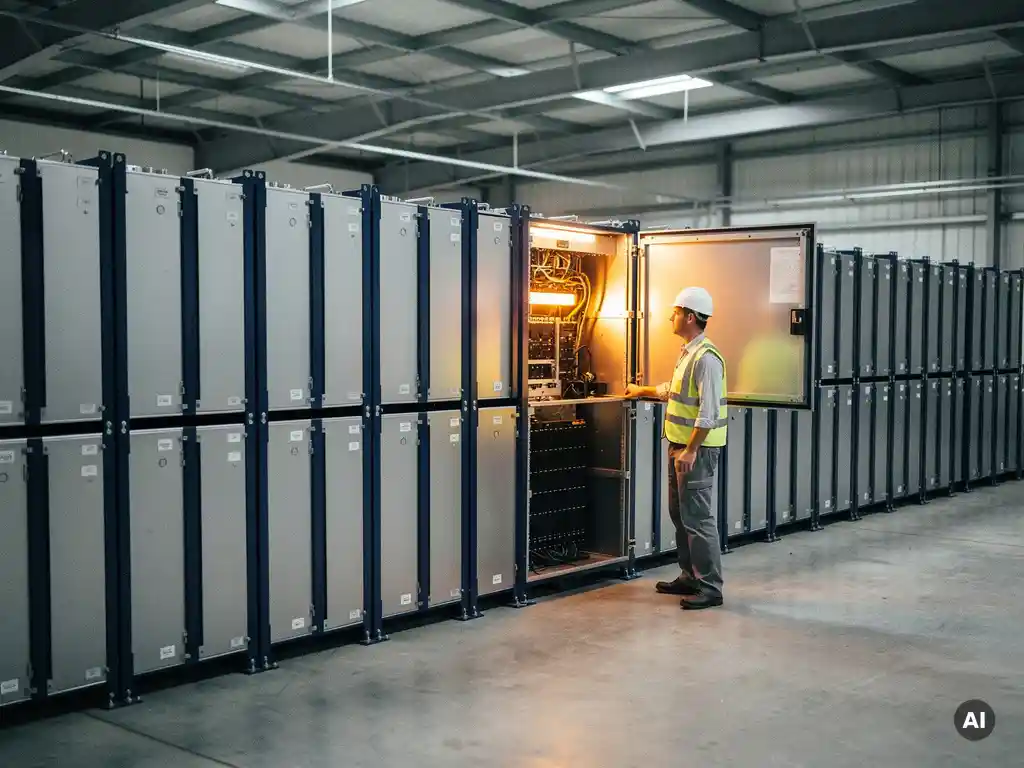

Modular battery storage is an energy storage approach where individual battery units are designed to be combined, stacked, or scaled to meet a specific power and capacity requirement. Rather than installing a single fixed-size system, modular storage lets you start with what you need today and expand as demand grows. The sections below break down how these systems work, what they’re made of, and when they make sense for solar projects.
How does modular battery storage work?
Modular battery storage works by linking multiple standardized battery units together to form a larger, scalable energy storage system. Each module operates as a self-contained unit with its own cells, battery management system, and thermal controls. When connected, the modules share a common inverter or power conversion system and communicate through a central energy management system that coordinates charging and discharging across the entire array.
The key principle is parallelism. Instead of one large, monolithic battery bank, you have many smaller units working in coordination. This architecture means the system can be expanded by simply adding more modules without redesigning the entire installation. It also means that if one module develops a fault, it can often be isolated and replaced without taking the whole system offline.
From an engineering standpoint, the battery management system plays a critical role. It monitors cell voltage, temperature, and state of charge across every module, balancing the load to prevent any single unit from being overworked or undercharged. This active balancing is what makes large modular arrays perform reliably over time.
What are the main components of a modular battery storage system?
A modular battery storage system consists of four core components: the battery modules themselves, a battery management system (BMS), a power conversion system (PCS) or inverter, and an energy management system (EMS). Together, these components handle energy storage, safety monitoring, AC/DC conversion, and system-wide control.
Battery modules
Each module contains a set of electrochemical cells, most commonly lithium iron phosphate (LFP) chemistry for commercial and utility-scale applications due to its thermal stability and long cycle life. The module housing includes busbars, connectors, and often integrated cooling channels to manage heat during high-rate charge and discharge cycles.
Battery management system
The BMS is the intelligence layer inside each module. It continuously monitors individual cell voltages and temperatures, triggers protection mechanisms if parameters go out of range, and communicates state-of-charge data to the broader energy management system. A well-designed BMS is what separates a safe, long-lasting modular system from one that degrades quickly or poses a safety risk.
Power conversion system and energy management system
The PCS converts DC energy stored in the batteries to AC power for grid or load use, and vice versa during charging. The EMS sits above everything else, coordinating when the system charges, when it discharges, and how it responds to grid signals or on-site demand. In solar-plus-storage configurations, the EMS also manages the relationship between PV generation, battery state, and export or self-consumption targets.
What’s the difference between modular and traditional battery storage?
The core difference between modular and traditional battery storage is scalability and flexibility. Traditional battery storage systems are typically designed as fixed-capacity installations, sized once at the point of procurement and difficult or expensive to expand later. Modular systems are built from interchangeable units that can be added or reconfigured as project requirements change.
Traditional systems often require custom engineering for each project, which increases upfront design time and cost. Modular systems use standardized building blocks, which simplifies procurement, installation, and future maintenance. Replacement parts are more readily available, and technicians can be trained on a single module type that applies across many different system sizes.
From a risk perspective, traditional monolithic systems create a single point of failure. If the core battery bank fails or degrades significantly, the entire storage capacity is affected. In a modular system, degradation or failure is typically isolated to one or a few modules, and the rest of the system continues operating. This resilience is particularly valuable in commercial and industrial applications where uptime directly affects operations.
Cost structures also differ. Traditional systems may have a lower per-kWh cost at a specific design capacity, but modular systems offer a better total cost of ownership when you factor in the ability to right-size the initial investment and expand incrementally rather than overbuilding from day one.
What are the advantages of modular battery storage for solar projects?
The main advantages of modular battery storage for solar projects are scalability, faster deployment, easier maintenance, and the ability to match storage capacity precisely to evolving energy needs. These benefits are especially relevant for commercial, industrial, and utility-scale PV installations where project requirements often shift between initial design and final commissioning.
- Scalability: Storage capacity can grow alongside PV generation capacity or changing load profiles without replacing the entire system.
- Faster installation: Standardized modules reduce on-site engineering time and allow parallel installation workflows.
- Reduced downtime risk: Faulty modules can be swapped out without shutting down the full system, improving overall availability.
- Simplified logistics: Uniform module sizes are easier to transport, handle, and store on large project sites.
- Future-proofing: As battery technology improves, newer modules can often be integrated into an existing modular architecture, extending the useful life of the overall system.
- Financing flexibility: Phased deployment allows capital expenditure to be spread over time, which can improve project economics and investor appetite.
For solar developers working across multiple project types, modular storage also simplifies the engineering process. A single system architecture can be adapted to a 500 kWh commercial rooftop project and a 10 MWh ground-mount installation by adjusting the number of modules rather than redesigning from scratch each time.
What are the limitations of modular battery storage systems?
Modular battery storage systems have real limitations, including potentially higher per-unit costs at smaller scales, increased complexity in system integration, and the need for careful compatibility management when mixing modules from different production batches or generations. These factors are worth evaluating carefully before committing to a modular architecture.
At small capacities, the standardized module format can mean you’re paying for more engineering and enclosure overhead than a purpose-built small system would require. The cost advantage of modularity tends to become more pronounced at medium to large scales where the flexibility and scalability benefits outweigh the per-unit premium.
Integration complexity is another real consideration. Connecting many modules in parallel or series requires careful attention to cable sizing, busbar ratings, and protection coordination. If modules from different manufacturers or firmware versions are combined, communication protocols may not align cleanly, creating reliability risks. This is an area where a thorough engineering review during the design phase pays dividends at commissioning.
Thermal management also becomes more complex as systems scale. Each additional module adds heat load, and ensuring adequate cooling across a large modular array requires deliberate layout planning and, in some climates, active cooling infrastructure. Underestimating this during design is a common source of performance issues in the field.
When should a solar project use modular battery storage?
A solar project should use modular battery storage when future capacity expansion is likely, when phased deployment is financially or logistically preferable, or when high system availability is a project requirement. It is particularly well-suited to commercial and industrial projects where load profiles may evolve and downtime has direct operational consequences.
Modular storage makes the most sense in the following scenarios:
- Phased solar development: If a site is being developed in stages, modular storage allows battery capacity to be added in line with each phase of PV installation rather than overbuilding upfront.
- Uncertain future loads: Industrial facilities with plans to add EV charging, new production lines, or expanded operations benefit from the ability to scale storage without a full system replacement.
- High uptime requirements: Projects where energy storage downtime is costly, such as critical facilities or grid-balancing applications, benefit from the redundancy that modular architectures provide.
- Multi-site portfolios: Developers or EPCs managing multiple projects can standardize on a single modular platform, reducing procurement complexity and training requirements across their portfolio.
- Utility-scale projects with long development timelines: Large projects often see specification changes between initial design and commissioning. Modular systems are more forgiving of mid-project adjustments to capacity targets.
Where modular storage is less ideal is in small, one-off residential or light commercial installations with stable, well-defined energy needs and no realistic prospect of future expansion. In those cases, a purpose-built fixed-capacity system may offer a simpler and more cost-effective solution.
For solar engineering teams working through the design and sizing decisions that come with battery-integrated PV projects, having the right tools to model system performance and automate calculations makes a significant difference. If you want to see how purpose-built solar design software can support these workflows, explore what our platform offers or get in touch with our team to discuss your project requirements.
Frequently Asked Questions
How do I determine the right number of modules to start with for a new solar-plus-storage project?
Start by modeling your peak demand, daily energy consumption, and desired backup duration, then size your initial module count to meet current needs with a realistic buffer. Avoid the temptation to overbuild upfront — one of the core advantages of modular systems is that you can add capacity incrementally as actual load data becomes available. Working with solar design software that integrates storage sizing calculations will help you arrive at a defensible starting point without over-investing in day one capacity.
Can modules from different manufacturers or generations be mixed in the same modular battery system?
In most cases, mixing modules from different manufacturers or even different firmware generations of the same product is not recommended and can introduce serious reliability risks. Differences in communication protocols, state-of-charge reporting, and cell chemistry can prevent the BMS and EMS from accurately balancing the array, leading to premature degradation or protection faults. If expansion is planned, the safest approach is to standardize on a single module platform from the outset and confirm compatibility requirements with the manufacturer before adding new units later.
What is the typical lifespan of a modular battery storage system, and how does degradation affect scalability?
Most commercial-grade lithium iron phosphate modular systems are rated for 4,000 to 6,000 full charge-discharge cycles, which typically translates to 10 to 15 years of useful life depending on operating conditions. Degradation in a modular system tends to be more manageable than in monolithic systems because individual modules that fall below acceptable capacity thresholds can be replaced without retiring the entire installation. When planning long-term expansions, factor in the state of health of existing modules so that newer, higher-capacity additions don't create imbalances within the array.
What are the most common mistakes made during the installation of a modular battery storage system?
The most frequent installation mistakes include undersizing cable and busbar ratings for the full expanded system capacity, neglecting thermal management planning for future module additions, and skipping thorough commissioning tests on individual modules before integrating them into the array. Another common error is failing to account for communication wiring and protocol configuration when modules are added in later phases, which can cause EMS coordination failures. Conducting a detailed engineering review that accounts for the system's maximum intended scale — not just its day-one configuration — prevents the majority of these issues.
How does modular battery storage interact with grid export limits and self-consumption optimization in solar projects?
The energy management system in a modular storage setup can be configured to enforce export caps by absorbing excess PV generation into the battery rather than pushing it to the grid, making it a practical tool for complying with grid connection agreements. For self-consumption optimization, the EMS coordinates battery dispatch to maximize the use of on-site solar generation before drawing from the grid, which directly improves the economics of the project. As more modules are added, the EMS dispatch logic scales with the system, so self-consumption and export control strategies don't need to be reconfigured from scratch with each expansion.
Is active cooling always required for modular battery storage systems, or can some installations rely on passive thermal management?
Passive thermal management — relying on natural convection and module housing design to dissipate heat — is sufficient for many small to medium modular systems operating in moderate climates with conservative charge and discharge rates. However, as system size increases or ambient temperatures rise, passive cooling becomes inadequate and active cooling infrastructure such as liquid cooling loops or forced-air systems becomes necessary to maintain safe operating temperatures. Always review the manufacturer's thermal derating curves for your specific climate and duty cycle before deciding whether active cooling is required, since underestimating heat load is one of the leading causes of accelerated degradation in field installations.
What should I look for when evaluating modular battery storage products for a commercial or utility-scale solar project?
Key evaluation criteria include the module's cycle life rating and warranty terms, the maturity and flexibility of the BMS and EMS software, the manufacturer's track record in projects of comparable scale, and the availability of spare parts and local technical support. Pay close attention to the communication protocols supported — systems that use open standards such as Modbus or CAN bus are generally easier to integrate with third-party EMS platforms and grid management systems. Finally, confirm that the modular architecture has been independently certified and tested as a complete system, not just at the individual module level, since system-level safety and performance can differ significantly from component-level specifications.
Related Articles
- What is a three-line diagram vs a single line diagram?
- What is the relationship between battery sizing and DC/AC ratio?
- How do you validate battery sizing calculations before construction?
- What is the difference between usable and total battery capacity?
- What makes solar project documentation so time-intensive?
This content was generated with the help of AI — it may contain mistakes