
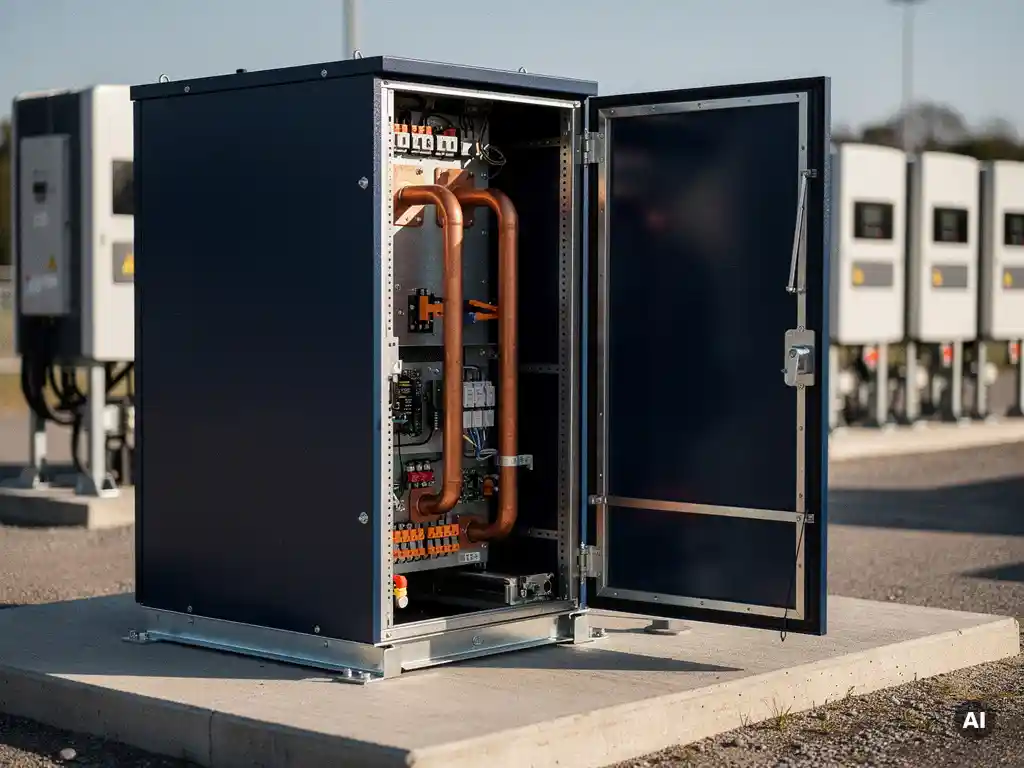

The main difference between AC-coupled and DC-coupled BESS (Battery Energy Storage Systems) is where the battery connects to the solar PV system. In an AC-coupled setup, the battery connects on the AC side of the inverter. In a DC-coupled setup, the battery connects on the DC side, before the inverter converts power. The right choice depends on your project type, system size, and design priorities, and it has real consequences for efficiency, cost, and engineering complexity.
Both architectures are widely used in solar-plus-storage projects in 2026, and understanding the trade-offs between them is essential for engineers designing commercial, industrial, and utility-scale PV systems. This article walks through how each coupling type works, where each one wins, and how your choice shapes the engineering calculations behind the system.
Which coupling architecture is more efficient for solar-plus-storage?
DC-coupled BESS is generally more efficient than AC-coupled BESS in solar-plus-storage systems. Because DC-coupled storage avoids an extra conversion step when charging from solar, it typically achieves round-trip efficiency gains of a few percentage points. However, AC-coupled systems remain highly competitive in retrofit scenarios and larger utility-scale projects where flexibility outweighs marginal efficiency differences.
Efficiency in a BESS context is measured as round-trip efficiency: the ratio of energy put into the battery to energy retrieved from it. Every power conversion step introduces losses, typically in the range of 2 to 5 percent per conversion. In a DC-coupled system, solar energy flows directly from the PV array into the battery via a charge controller or bidirectional DC-DC converter, with only one conversion to AC happening at the inverter output. In an AC-coupled system, solar energy is first converted to AC by the PV inverter, then converted back to DC to charge the battery, then converted to AC again when the battery discharges. That extra conversion cycle adds up over time, particularly in systems with high charge-discharge cycling.
That said, efficiency is rarely the only variable that matters. System design constraints, grid interconnection requirements, and project economics often make AC coupling the more practical choice despite the slight efficiency penalty.
How does AC-coupled BESS connect to a solar PV system?
In an AC-coupled BESS, the battery system connects to the AC bus of the solar PV system, after the solar inverter has already converted DC power from the panels into AC power. The battery has its own dedicated bidirectional inverter that handles both charging and discharging independently from the PV inverter.
This means the two systems, the solar array and the battery, operate largely independently. The PV inverter does its job converting solar DC to AC, and the battery inverter manages energy flow to and from the battery on the AC side. When solar generation exceeds demand, the battery inverter takes AC power from the bus, converts it to DC to charge the battery, and later converts it back to AC when discharging to the grid or loads.
Because the battery system is essentially a separate AC device, AC-coupled BESS integrates easily with existing PV installations. You can add storage to an already commissioned solar plant without touching the existing PV inverters or DC wiring. This makes AC coupling the dominant architecture for retrofitting storage onto operational solar assets. It also simplifies grid interconnection in many markets, since the battery inverter can be independently controlled and metered.
How does DC-coupled BESS connect to a solar PV system?
In a DC-coupled BESS, the battery connects directly to the DC side of the solar PV system, before the main inverter. A bidirectional DC-DC converter or a hybrid inverter manages the flow of power between the PV array, the battery, and the AC grid, all within a single conversion pathway.
In practice, this often means using a hybrid inverter that handles both the PV input and the battery input simultaneously, converting everything to AC in one step. Alternatively, a separate DC-DC charge controller can sit between the PV array and the battery on the DC bus, feeding into a shared inverter. Either way, the key characteristic is that solar energy can charge the battery without ever being converted to AC first.
DC coupling is particularly well suited to new-build projects where the entire system, panels, battery, and inverter, is designed together from the start. It is also advantageous in off-grid and island-mode applications where precise DC bus management is critical. The trade-off is that DC-coupled systems are more tightly integrated, making it harder to expand or modify the battery capacity independently after commissioning.
What are the main advantages and disadvantages of each coupling type?
AC-coupled and DC-coupled BESS each carry a distinct set of strengths and limitations. The best choice depends on whether you are designing a new system or retrofitting an existing one, how much you prioritize efficiency versus flexibility, and what your inverter and grid requirements look like.
AC-coupled BESS: advantages and disadvantages
- Advantage: Easy to retrofit onto existing PV systems without modifying DC wiring or replacing inverters
- Advantage: Battery and solar systems can be independently sized, upgraded, or replaced
- Advantage: Simpler grid interconnection in many regulatory frameworks, since the battery inverter is a separate, controllable AC device
- Advantage: Works with virtually any existing PV inverter brand or topology
- Disadvantage: Lower round-trip efficiency due to the additional AC-to-DC-to-AC conversion cycle when charging from solar
- Disadvantage: Requires two inverters (PV inverter plus battery inverter), increasing equipment cost and footprint
- Disadvantage: More complex energy management when coordinating two independent inverter systems
DC-coupled BESS: advantages and disadvantages
- Advantage: Higher round-trip efficiency because solar charges the battery without an intermediate AC conversion
- Advantage: Fewer inverter components when using a hybrid inverter, reducing cost and simplifying the balance of system
- Advantage: Better suited for off-grid, island-mode, and self-consumption optimization scenarios
- Advantage: Allows clipping recovery: energy that would be lost when the PV array exceeds the inverter’s AC capacity can be redirected to charge the battery instead
- Disadvantage: Harder to retrofit onto existing PV systems without significant redesign
- Disadvantage: Battery and solar are more tightly coupled, making independent upgrades more complex
- Disadvantage: Hybrid inverters may limit flexibility in large utility-scale projects with complex grid requirements
When should a solar project use AC-coupled vs. DC-coupled storage?
Use AC-coupled BESS when retrofitting storage onto an existing solar installation, when the project requires independent control of the battery system, or when regulatory requirements favor separate metering of generation and storage. Use DC-coupled BESS when designing a new solar-plus-storage system from scratch, when maximizing self-consumption efficiency is a priority, or when clipping recovery from an oversized PV array adds meaningful value.
For commercial and industrial (C&I) projects where a solar plant is already operational, AC coupling is almost always the practical choice. Adding a battery inverter on the AC bus avoids any disruption to the existing PV system and keeps the two systems independently serviceable. For new utility-scale projects where the entire system is engineered together, DC coupling often makes more financial and technical sense, particularly when the DC/AC ratio is deliberately set high to capture clipping losses through battery charging.
Off-grid and microgrid applications strongly favor DC coupling because tight DC bus management is essential for stable island-mode operation. Grid-tied projects with complex ancillary service requirements, such as frequency response or voltage support, may favor AC coupling because the battery inverter can be independently dispatched and controlled without affecting PV generation.
If you are unsure which architecture fits your specific project, speaking with a solar engineering specialist can help you evaluate the trade-offs against your actual site conditions and grid requirements.
How does coupling type affect solar system design and engineering calculations?
The coupling architecture you choose directly affects several core engineering calculations, including DC/AC ratio, inverter sizing, cable sizing, protection coordination, and energy yield modeling. These are not minor adjustments, choosing AC versus DC coupling can change the fundamental topology of the single-line diagram and the sizing logic for every major component downstream.
In a DC-coupled system, the inverter must be sized to handle both the PV array output and the battery discharge simultaneously. This changes the inverter loading profile and affects how you calculate the DC/AC ratio. DC-coupled systems also often use a higher DC/AC ratio intentionally, relying on the battery to absorb clipping energy, which means the clipping recovery calculation becomes a key input to the financial model. String configuration and cable sizing on the DC side must account for the combined current paths between the array, the charge controller, and the battery.
In an AC-coupled system, the PV inverter is sized independently from the battery inverter, which simplifies the DC-side calculations but adds complexity on the AC side. Protection coordination must account for two inverter sources feeding the same AC bus, which has implications for fault current calculations, relay settings, and grid interconnection studies. The single-line diagram becomes more complex, with two inverter branches merging at the AC distribution point.
Energy yield modeling also differs between the two topologies. AC-coupled systems model the battery as a separate AC load and source, while DC-coupled systems require modeling the DC bus dynamics, including clipping recovery, to accurately predict annual energy throughput. Tools like PVsyst handle these topologies differently, and engineers need to configure the simulation model correctly to avoid overestimating or underestimating system performance.
For engineering teams working on C&I and utility-scale projects, managing these calculations manually across Excel and AutoCAD creates significant risk of errors, especially when the coupling architecture changes mid-design. Virto Solar’s design software is built to handle exactly this kind of complexity, automating string planning, cable sizing, SLD generation, and BOM outputs within the CAD environment engineers already work in, so that a change in system topology does not trigger hours of manual rework across every downstream calculation.
Frequently Asked Questions
Can I switch from AC-coupled to DC-coupled BESS after my system is already installed?
Switching from AC-coupled to DC-coupled after commissioning is technically possible but rarely cost-effective. It typically requires replacing the existing PV inverter with a compatible hybrid inverter, redesigning the DC wiring architecture, and potentially re-engineering the string configuration — all of which can approach the cost of a new installation. In most retrofit scenarios, it makes more financial sense to stay with AC coupling or to plan for DC coupling from the outset on new-build projects.
What is clipping recovery, and how much energy can it realistically save in a DC-coupled system?
Clipping recovery refers to capturing solar energy that would otherwise be lost when a PV array's DC output exceeds the inverter's rated AC capacity — a common situation in systems with a high DC/AC ratio. In a DC-coupled system, that excess DC power is redirected to charge the battery instead of being curtailed. The actual energy savings depend on your DC/AC ratio, local irradiance profile, and battery capacity, but in systems with DC/AC ratios above 1.3, clipping recovery can represent a meaningful improvement in annual energy yield and should be explicitly modeled in your financial projections.
How do I size the battery inverter in an AC-coupled system relative to the PV inverter?
In an AC-coupled system, the battery inverter is sized based on the desired charge and discharge power rates, not the PV array capacity. A common starting point is to size the battery inverter to match the peak load demand or the grid export limit, whichever is the binding constraint for your project. Keep in mind that the battery inverter must also be capable of handling the AC power flowing from the PV inverter during charging cycles, so your energy management system needs to coordinate both inverters to avoid overloading the AC bus.
Does the choice of AC vs. DC coupling affect how the system performs during a grid outage?
Yes, and this is one of the more important practical distinctions between the two architectures. DC-coupled systems using a hybrid inverter are generally better equipped for seamless islanding and off-grid operation because the inverter manages the DC bus directly and can maintain stable output without grid reference. AC-coupled systems can also provide backup power, but they require careful anti-islanding coordination between the PV inverter and the battery inverter — some PV inverters will shut down during a grid outage unless specifically configured for grid-forming or backup operation, which can leave the battery unable to charge from solar while islanded.
What are the most common engineering mistakes made when designing DC-coupled BESS systems?
The most frequent mistakes include undersizing the hybrid inverter by failing to account for simultaneous PV and battery discharge currents, miscalculating the DC/AC ratio without factoring in clipping recovery dynamics, and neglecting to model the battery's state-of-charge constraints in the energy yield simulation. Engineers also sometimes overlook the protection coordination requirements on the DC bus, particularly when a separate DC-DC charge controller is used alongside a shared inverter. Running the energy model without correctly configuring the DC-coupled topology in simulation tools like PVsyst is another common source of performance overestimation.
How does coupling type affect grid interconnection studies and utility approval timelines?
AC-coupled systems often have a smoother path through interconnection studies because the battery inverter is treated as a separate, independently controllable AC device that utilities and grid operators are more familiar with evaluating. DC-coupled systems, particularly those using hybrid inverters, may require additional documentation to clarify how the combined PV-plus-storage output is controlled and metered, which can add time to the interconnection review process in some jurisdictions. It is worth confirming your local utility's interconnection requirements early in the design phase, as coupling architecture can influence which IEEE standards apply and what protection settings are required.
Are there specific project sizes or scales where one coupling type clearly dominates?
At the residential and small commercial scale, DC coupling with a hybrid inverter is increasingly the default choice because it simplifies the system into a single integrated unit and optimizes self-consumption. At the large commercial, industrial, and utility scale — typically above 1 MW — AC coupling becomes more common because it offers greater flexibility in independently sizing, controlling, and expanding the storage system, and because large-format battery inverters are well-established in those markets. That said, DC-coupled architectures are gaining ground at utility scale as hybrid inverter technology matures and clipping recovery becomes a more significant financial driver in high DC/AC ratio project designs.
Related Articles
- What is a solar wiring diagram?
- What is behind-the-meter battery storage?
- What are the benefits of battery storage for commercial buildings?
- What information should a solar wiring diagram include for commissioning?
- How do you optimize solar layouts for maximum efficiency?
This content was generated with the help of AI — it may contain mistakes