
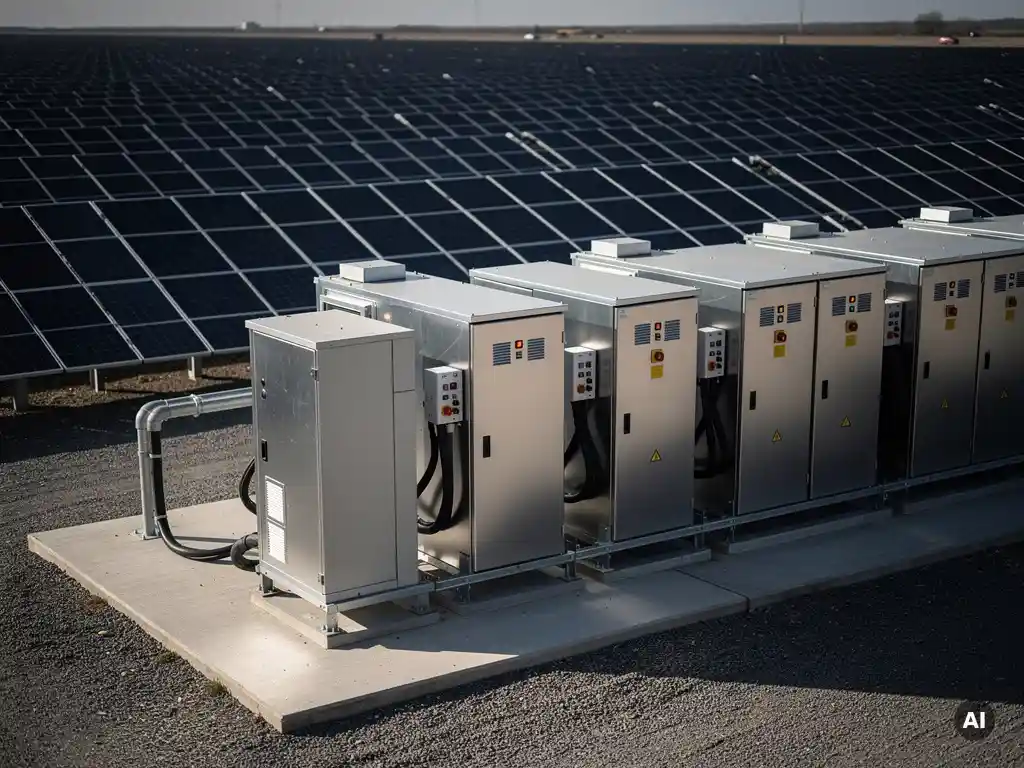

Battery storage for solar energy is a system that captures excess electricity generated by solar panels and stores it in rechargeable batteries for use when the sun is not producing power. Instead of sending surplus energy back to the grid or losing it entirely, a battery system holds that energy and makes it available on demand. The sections below cover how these systems work, the main technology types, key technical concepts, and how to determine whether storage makes sense for a given project.
How does battery storage work with a solar system?
Battery storage works with a solar system by capturing surplus DC electricity from the panels, converting it to the appropriate form, and storing it in a battery bank until it is needed. When solar generation exceeds on-site consumption, the excess energy charges the battery rather than being exported. When generation falls short, the battery discharges to cover the load gap.
The core components of a solar-plus-storage system are the PV array, a charge controller or inverter, the battery bank, and a battery management system (BMS). The BMS monitors cell voltage, temperature, and state of charge to protect the batteries from overcharging or deep discharge, extending their operational lifespan.
In practice, the system follows a priority logic: solar generation first meets on-site demand, then charges the battery, and any remaining surplus is exported to the grid. When the sun sets or generation drops, the battery discharges to supply the load before the site draws from the grid. This dispatch logic can be programmed to optimize for self-consumption, peak shaving, or grid services depending on the project’s commercial goals.
What are the main types of solar battery storage?
The main types of solar battery storage are lithium-ion, lead-acid, flow batteries, and sodium-ion. Lithium-ion dominates the commercial and utility-scale market today because of its high energy density, long cycle life, and falling manufacturing costs. Each chemistry involves different trade-offs in cost, lifespan, safety, and application suitability.
Lithium-ion batteries
Lithium-ion is the most widely deployed technology in solar storage projects. Within this category, lithium iron phosphate (LFP) has become the preferred chemistry for stationary storage because of its thermal stability and long cycle life, often exceeding 4,000 to 6,000 cycles. Nickel manganese cobalt (NMC) offers higher energy density but carries greater thermal risk, making LFP the safer choice for large installations.
Lead-acid batteries
Lead-acid batteries are the oldest rechargeable technology and remain in use for smaller off-grid and backup applications where upfront cost is the primary constraint. They are heavier, have a lower depth of discharge, and degrade faster than lithium-ion, but they are well understood and widely serviceable. For commercial or utility-scale projects in 2026, lead-acid is rarely the first choice unless the application is very specific.
Flow batteries and emerging chemistries
Flow batteries store energy in liquid electrolytes held in external tanks, making capacity and power independent of each other. This makes them attractive for long-duration storage applications of four hours or more. Vanadium redox flow batteries are the most commercially mature variant. Sodium-ion batteries are an emerging alternative that avoids lithium and cobalt supply chain concerns, though they are not yet as widely deployed in solar projects as lithium-ion.
What is the difference between AC-coupled and DC-coupled storage?
The difference between AC-coupled and DC-coupled storage lies in where the battery connects within the system. In a DC-coupled setup, the battery connects on the DC side of the inverter, so solar energy flows directly into the battery without an extra conversion step. In an AC-coupled setup, the battery connects on the AC side, meaning energy is converted from DC to AC by the solar inverter before being converted again to DC for storage.
DC-coupled systems are generally more efficient because they involve fewer energy conversion steps, making them the preferred choice for new-build projects where the storage system is designed alongside the PV array from the start. The round-trip efficiency advantage can be meaningful at scale, where even a one- or two-percentage-point difference in conversion loss translates to measurable energy and revenue impact over the system’s lifetime.
AC-coupled systems are easier to retrofit onto existing solar installations because the battery and its inverter can be added independently without modifying the existing PV inverter. They also offer greater flexibility when the battery needs to charge from the grid as well as from solar. For projects where storage is being added to an already commissioned plant, AC coupling is often the more practical path, even if it carries a slight efficiency penalty.
What is a battery’s depth of discharge and why does it matter?
Depth of discharge (DoD) is the percentage of a battery’s total capacity that is used in a single cycle. A battery with a 100 kWh capacity discharged to 80% DoD delivers 80 kWh before recharging. DoD matters because discharging a battery too deeply too frequently accelerates degradation and shortens its usable lifespan.
Most lithium-ion batteries for solar storage are rated at a recommended maximum DoD of 80 to 90 percent. Operating consistently within that range preserves cycle life and keeps the battery performing within its warranty conditions. Lead-acid batteries are more sensitive, with recommended DoD limits of 50 percent or less, which effectively halves their usable capacity compared to their nameplate rating.
When sizing a storage system, engineers must account for DoD to ensure the usable capacity meets the project’s energy requirements. A 100 kWh battery with an 80% DoD limit provides only 80 kWh of usable energy. Specifying a system based on nameplate capacity without factoring in DoD leads to undersized storage and unmet load requirements, which is a common and costly design error.
When does adding battery storage to a solar project make sense?
Adding battery storage to a solar project makes sense when there is a clear economic or operational benefit that justifies the additional capital cost. The strongest cases are sites with high peak demand charges, time-of-use tariffs with significant price differentials, unreliable grid connections, or a requirement for backup power during outages.
For commercial and industrial sites, peak shaving is often the primary driver. If a facility pays demand charges based on its highest 15- or 30-minute consumption interval in a billing period, a battery that flattens those peaks can deliver substantial savings. The viability depends on the local tariff structure and the size of the demand charge relative to the storage system cost.
Time-of-use arbitrage is another common justification. If grid electricity is significantly more expensive during evening hours than during the day, storing solar generation and discharging it during peak pricing periods improves the project’s economics. The value of this strategy depends entirely on the spread between off-peak and peak rates.
For utility-scale projects, storage increasingly enables grid services such as frequency regulation and capacity firming, which can generate additional revenue streams. Off-grid and remote sites represent the clearest technical case for storage, where the battery is essential for continuous power supply rather than an economic optimization. If none of these conditions apply and the grid connection is stable with flat tariffs, storage may not add sufficient value to justify the investment at this stage of the technology’s cost curve.
How is solar battery storage sized for a project?
Solar battery storage is sized by determining the required usable energy capacity and the peak power output needed for the intended application. The starting point is the load profile: how much energy the site consumes during the hours when solar is not generating, and what the peak demand looks like during those periods. From there, the designer works backward to specify a battery with sufficient usable capacity and discharge rate.
The key inputs for sizing are the daily energy requirement during discharge periods, the target number of hours of autonomy or backup duration, the battery’s usable DoD, and the round-trip efficiency of the system. For example, if a site needs 50 kWh of stored energy and the battery has an 80% DoD, the required nameplate capacity is at least 62.5 kWh before accounting for efficiency losses.
For peak shaving applications, the sizing logic shifts toward power output rather than energy capacity. The battery must be able to discharge at a rate high enough to suppress the demand peak, which means the inverter and battery power rating (measured in kilowatts) is as important as the energy rating (measured in kilowatt-hours). A system optimized purely for energy capacity may not have the discharge rate needed to cut a sharp demand spike.
Accurate sizing also requires a realistic solar generation profile, ideally based on measured irradiance data for the site location, to understand how much energy the battery will actually receive on a typical day. Tools that integrate yield simulation with storage dispatch modeling give engineers a much clearer picture of system performance before committing to hardware. If you are working through the engineering for a storage-integrated PV project and want to explore how software can support that process, get in touch with our team to discuss your project requirements.
Frequently Asked Questions
What is a realistic lifespan for a solar battery storage system, and how does degradation affect performance over time?
Most lithium iron phosphate (LFP) battery systems are designed for a lifespan of 10 to 15 years, with manufacturers typically warranting 70–80% of original capacity retention after a specified number of cycles (often 4,000 to 6,000). In practice, degradation is gradual — a battery delivering 100 kWh in year one might deliver around 80 kWh by year ten. Planning for this capacity fade is important during sizing: engineers often add a degradation buffer so the system still meets energy requirements at the end of its warranted life, not just at commissioning.
Can a solar battery storage system power my site during a grid outage, and what does that require?
Yes, but only if the system is specifically designed for islanding or backup operation — this capability is not automatic. A standard grid-tied solar-plus-storage system will shut down during a grid outage for safety reasons unless it includes an automatic transfer switch and an inverter rated for off-grid or backup mode. If backup power is a project requirement, it must be specified at the design stage, as it affects inverter selection, system architecture, and potentially the battery sizing needed to sustain critical loads for the required duration.
What are the most common mistakes made when specifying or installing a solar battery storage system?
The most frequent errors are sizing based on nameplate capacity rather than usable capacity (ignoring DoD limits), underestimating peak power requirements by focusing only on energy (kWh) without adequately sizing for discharge rate (kW), and failing to account for round-trip efficiency losses in energy yield projections. Another common oversight is neglecting thermal management: batteries installed in poorly ventilated or extreme-temperature environments degrade significantly faster than lab-rated cycle counts suggest. Engaging a qualified storage engineer and using dispatch simulation tools before finalizing hardware specifications helps avoid these costly mistakes.
How do time-of-use tariffs affect the return on investment for a solar-plus-storage project?
Time-of-use (TOU) tariffs are one of the strongest economic drivers for storage, but the value depends entirely on the spread between off-peak and peak electricity rates. A site with a peak-to-off-peak price differential of $0.15/kWh or more will generally see a much stronger business case than one with a flat or mildly variable tariff. It is also important to model how many hours per day the battery can realistically cycle at the arbitrage spread, since a system that only captures a narrow window of high prices each day may take significantly longer to recover its capital cost.
Is it better to install battery storage at the same time as the solar panels, or can it be added later?
Installing storage at the same time as the solar array is generally more cost-effective and technically optimal, particularly for DC-coupled configurations where the battery integrates directly with the PV inverter. Retrofitting storage to an existing system typically requires an AC-coupled approach, which adds hardware costs and introduces a slight efficiency penalty from the additional conversion step. That said, a well-planned AC-coupled retrofit is a viable path and may make financial sense if battery costs continue to fall — the key is ensuring the original solar installation is designed with future storage in mind, including adequate switchboard capacity and space for battery enclosures.
What safety considerations are specific to large-scale lithium-ion battery storage installations?
Thermal runaway is the primary safety concern with lithium-ion systems at scale: if a cell overheats due to a fault, it can trigger a chain reaction across adjacent cells. Reputable LFP systems mitigate this risk through robust battery management systems (BMS), cell-level fusing, and fire suppression systems integrated into the battery enclosure. At the installation level, projects must comply with local fire codes and standards (such as NFPA 855 in the US or equivalent national standards elsewhere), which govern minimum separation distances, ventilation requirements, and emergency response planning. Always verify that the chosen battery system carries relevant safety certifications (UL 9540, IEC 62619, etc.) before procurement.
What software or tools are typically used to model and optimize solar battery storage systems before installation?
Effective pre-installation modeling combines solar yield simulation with storage dispatch modeling to predict how the battery will charge and discharge across a full year of operation. Tools range from specialized PV design platforms that incorporate storage modules to dedicated energy storage optimization software that can model different dispatch strategies (self-consumption, peak shaving, arbitrage) against real tariff structures. Using actual measured irradiance data for the project location — rather than generic averages — significantly improves the accuracy of energy yield and financial projections, which is critical for investment decisions on larger commercial or utility-scale projects.
Related Articles
- How do you create a wiring diagram for a solar carport system?
- What are the benefits of battery storage for commercial buildings?
- What are the main components of a battery storage system?
- How does PV design software work for large-scale solar projects?
- How do you speed up solar project development timelines?
This content was generated with the help of AI — it may contain mistakes