
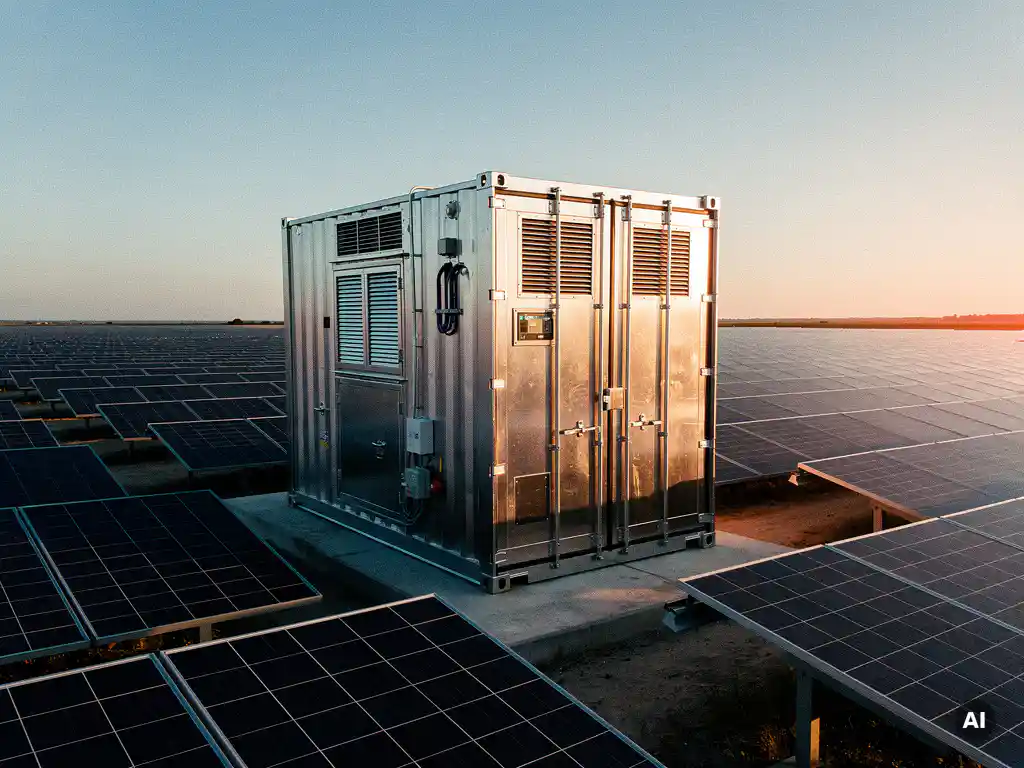

Containerized battery storage is a self-contained energy storage system housed inside a standard shipping container or purpose-built enclosure, combining battery modules, power conversion equipment, thermal management, and control systems into a single deployable unit. This format makes large-scale battery storage practical for solar projects because the entire system arrives pre-assembled and pre-tested, dramatically reducing on-site installation time. The sections below unpack how these systems work, what types of batteries they use, how they compare to non-containerized alternatives, and where they fit into real solar projects.
How does containerized battery storage actually work?
A containerized battery energy storage system (BESS) works by storing electrical energy in battery cells during periods of surplus generation and releasing that energy back to the grid or load when demand exceeds supply. The container houses all the components needed for this cycle: battery modules, a battery management system (BMS), power conversion system (PCS), thermal management, and a supervisory control interface, all wired, tested, and ready to connect on arrival.
When solar generation peaks midday, excess DC power flows into the battery modules through the power conversion system, which manages the charge rate and protects cell health. The BMS monitors individual cell voltages, temperatures, and state of charge in real time, balancing the load across the battery pack and preventing conditions that would degrade performance or create safety risks.
During discharge, the process reverses. The PCS converts stored DC energy back to AC power at the voltage and frequency required by the connected grid or facility. A supervisory control system, often integrated with the site’s SCADA or energy management platform, determines when to charge and when to discharge based on grid signals, energy prices, or pre-set operational logic.
The containerized format means all of this complexity is resolved at the factory. Engineers on site connect the container to the grid interconnection point, commission the control software, and the system is operational, rather than spending weeks assembling individual components in the field.
What are the main types of batteries used in storage containers?
The most common battery chemistry used in containerized storage systems today is lithium iron phosphate (LFP), followed by nickel manganese cobalt (NMC). LFP dominates large-scale solar-plus-storage projects because of its strong thermal stability, long cycle life, and lower fire risk compared to other lithium-ion variants. NMC offers higher energy density in a smaller footprint but carries greater thermal sensitivity.
Lithium iron phosphate (LFP)
LFP batteries have become the industry standard for utility-scale and commercial containerized BESS. Their chemistry is inherently more stable at high temperatures, which matters enormously when containers are deployed in warm climates or subject to high cycling rates. LFP cells typically support 4,000 to 6,000 full charge-discharge cycles before reaching 80% of their original capacity, making them well suited to daily cycling applications alongside solar generation.
Nickel manganese cobalt (NMC)
NMC batteries pack more energy into a given volume, which can be an advantage when space is constrained. However, their higher energy density comes with a narrower thermal operating window and a greater need for active cooling. NMC is more commonly found in smaller commercial systems or applications where footprint is the primary constraint rather than long-term cycle durability.
Beyond these two dominant chemistries, some containerized systems use lead-acid batteries in lower-cost or backup-focused applications, and flow batteries are beginning to appear in longer-duration storage containers where four to eight hours of discharge is required. Solid-state batteries remain largely pre-commercial for this application as of 2026.
What is the difference between containerized and non-containerized battery storage?
The key difference is integration and deployment speed. Containerized battery storage arrives as a complete, factory-assembled unit ready to connect to the grid, while non-containerized systems are built component by component on site, requiring more civil works, longer installation timelines, and more on-site engineering coordination.
Non-containerized systems, sometimes called rack-mounted or building-integrated BESS, install battery racks inside purpose-built rooms or dedicated structures. This approach offers more flexibility in how the system is configured and can be easier to expand incrementally, but it requires significant upfront construction and more complex on-site integration work. Every component, racks, cabling, cooling, fire suppression, must be installed and tested individually.
Containerized systems trade some of that flexibility for speed and predictability. Because the container is a standardized enclosure, manufacturers can pre-wire, pre-test, and pre-commission the system before it leaves the factory. On-site work is reduced to civil foundations, grid connection, and software commissioning. For large solar projects with aggressive timelines, this is a meaningful advantage.
The trade-off is that containerized systems are less easily customized once manufactured, and replacing or upgrading individual components mid-life can be more complex than in an open-rack environment. For projects where long-term modularity matters, non-containerized designs may offer more operational flexibility over a 20-year asset life.
What size containerized battery storage system do solar projects need?
The right size depends on the project’s energy objectives: whether the goal is peak shaving, self-consumption maximization, grid services, or backup power. As a starting point, most commercial and industrial solar-plus-storage projects pair storage capacity equivalent to one to four hours of the solar array’s peak output, while utility-scale projects increasingly target two to four hours of full-discharge capacity.
Sizing a containerized BESS involves three core parameters:
- Energy capacity (kWh or MWh): The total amount of energy the system can store and deliver in a single discharge cycle. This is driven by how many hours of output the project needs to shift or firm.
- Power rating (kW or MW): The maximum rate at which the system can charge or discharge. This determines how quickly the system can respond to demand spikes or grid signals.
- DC/AC ratio and inverter sizing: The relationship between the battery’s DC capacity and the AC output of the power conversion system affects how efficiently the system operates across different charge states.
A standard 20-foot container typically holds between 500 kWh and 1 MWh of usable energy depending on the battery chemistry and configuration. Utility-scale projects often deploy multiple containers in parallel, with total system capacities ranging from 5 MWh to several hundred MWh. For commercial rooftop projects, a single container unit is often sufficient to meet peak shaving or self-consumption targets.
Getting these numbers right at the design stage is critical. Undersizing the storage system leaves generation curtailed or grid export unrealized; oversizing it increases capital costs without proportional benefit. Accurate load profiling, generation forecasting, and grid tariff analysis all feed into a well-calibrated sizing decision.
Where is containerized battery storage typically installed?
Containerized battery storage systems are installed wherever large-scale energy storage is needed alongside or independent of solar generation. The most common installation locations are utility-scale solar farms, commercial and industrial facilities with high peak demand charges, grid substations providing frequency regulation or capacity services, and remote or island grids where reliable backup power is essential.
At utility-scale solar sites, containers are typically placed on concrete pads adjacent to the inverter stations, connected directly to the AC collection system or DC bus depending on the system architecture. The standardized container footprint simplifies civil planning and allows multiple units to be arranged in rows, scaling total capacity without redesigning the site layout.
Commercial and industrial installations often place containers in car parks, on the ground adjacent to the building, or within dedicated equipment yards. Because the container is self-contained, it does not require a dedicated equipment room inside the building, which reduces construction costs and simplifies permitting in many jurisdictions.
In remote or off-grid applications, containerized BESS units are frequently paired with diesel generators and solar arrays to form hybrid microgrids. The container’s portability is a genuine advantage here: systems can be transported to remote sites by road or sea and deployed without specialized construction infrastructure.
What are the key advantages and limitations of containerized BESS?
The primary advantages of containerized battery storage are faster deployment, factory-tested reliability, and scalability. The main limitations are reduced on-site flexibility, higher upfront cost per unit compared to some rack-based alternatives, and thermal management challenges in extreme climates.
Key advantages
- Faster commissioning: Factory assembly and pre-testing means on-site installation is measured in days rather than weeks, which is critical for projects with grid connection deadlines.
- Standardized quality: Every container leaves the factory having passed the same testing protocol, reducing the variability that can affect field-assembled systems.
- Scalability: Projects can add capacity by deploying additional containers without redesigning the existing system, making phased development straightforward.
- Portability: Containers can be relocated if a project’s requirements change or if the asset is repurposed at the end of the original project’s life.
- Integrated safety systems: Fire suppression, gas detection, and emergency shutdown systems are built into the container at the factory, reducing the risk of installation errors in the field.
Key limitations
- Limited customization: Once a container is manufactured, reconfiguring its internal layout or upgrading individual components is more complex than in an open-rack system.
- Thermal management demands: Containers in hot climates require robust active cooling to keep battery cells within their optimal temperature range, adding to operational energy consumption and maintenance requirements.
- Civil and logistics requirements: Containers need level, load-bearing foundations and crane or forklift access for placement, which adds to site preparation costs in some locations.
- End-of-life complexity: Replacing aged battery modules inside a sealed container system can be more involved than swapping racks in a purpose-built room, depending on the manufacturer’s design.
For most utility-scale and large commercial solar projects, the advantages of containerized storage outweigh these limitations, particularly where project timelines are tight and quality consistency is a priority. Engineers evaluating storage options should weigh these factors against the specific operational profile and site conditions of their project.
If you are working on a solar project that includes a storage component and want to understand how design software can support the engineering workflow from layout through to electrical calculations, explore what Virto Solar offers for PV engineering teams. For project-specific questions, you can also get in touch with our team directly.
Frequently Asked Questions
How do I get started with selecting a containerized BESS for my solar project?
Start by defining your project's core energy objectives — whether that's peak shaving, self-consumption, grid services, or backup power — and gather at least 12 months of load and generation data to inform sizing. From there, work with a qualified energy storage engineer or your EPC contractor to model different capacity scenarios against your grid tariff structure and interconnection requirements. Most reputable manufacturers offer pre-sales engineering support and can provide reference system configurations based on your project's power and energy targets.
What are the most common mistakes engineers make when sizing a containerized BESS for a solar project?
The most frequent mistake is sizing the battery based solely on solar array capacity rather than on actual load profiles and dispatch objectives, which often leads to either chronic underutilization or insufficient discharge duration. Another common error is overlooking the round-trip efficiency losses of the power conversion system, which typically range from 5–10%, meaning the system needs to store more energy than it ultimately delivers. Failing to account for battery degradation over the asset's life — and how that affects usable capacity in year 10 or 15 — is also a critical oversight that affects both financial modeling and system performance guarantees.
What thermal management systems are typically used inside containerized battery storage units?
Most modern containerized BESS units use active liquid cooling or precision air conditioning systems to maintain battery cells within their optimal operating temperature range, typically between 15°C and 35°C for LFP chemistry. Liquid cooling is increasingly preferred at utility scale because it offers more precise cell-level temperature control and lower parasitic energy consumption compared to air-based systems. In extreme climates — whether desert heat or arctic cold — additional insulation, heating elements, or enhanced cooling capacity may be specified at the factory to ensure the system performs reliably year-round.
Can containerized battery storage be expanded after initial deployment, and how does that work in practice?
Yes, one of the key advantages of the containerized format is that capacity can be scaled by deploying additional container units in parallel, without modifying the existing installation. In practice, this requires that the original site design accounts for future expansion — including sufficient civil pad space, electrical switchgear capacity, and grid interconnection headroom — so that adding containers later doesn't trigger a full site redesign. It's worth confirming with your manufacturer that new container units will be compatible with the existing BMS and supervisory control architecture, especially if the deployment spans several years and product generations.
What permits and approvals are typically required to install a containerized BESS at a commercial or utility-scale site?
Permitting requirements vary by jurisdiction, but most projects require building or construction permits for the civil foundations, electrical permits for the grid interconnection, and fire safety approvals given the battery chemistry involved. In many regions, containerized BESS installations must comply with standards such as NFPA 855 (Standard for the Installation of Stationary Energy Storage Systems) in the US, or equivalent national standards elsewhere, which govern minimum separation distances, fire suppression requirements, and ventilation. Engaging with the local authority having jurisdiction (AHJ) and your grid operator early in the project development phase is strongly recommended, as approval timelines can significantly affect your commissioning schedule.
How long does a containerized battery storage system typically last, and what happens at end of life?
Most containerized BESS units are designed for a 10–15 year operational life, with battery capacity typically degrading to around 70–80% of its original rated capacity by that point depending on cycling frequency and thermal management quality. At end of life, the options include battery module replacement within the existing container enclosure (if the manufacturer supports this), repurposing the degraded batteries for lower-demand second-life applications, or full decommissioning and recycling through certified battery recycling programs. Planning for end-of-life costs and responsibilities — including who owns the decommissioning obligation — should be addressed in procurement contracts and financial models from the outset.
How does a containerized BESS integrate with existing solar PV monitoring and SCADA systems?
Most modern containerized BESS units communicate via standard industrial protocols such as Modbus TCP, DNP3, or IEC 61850, which are compatible with the SCADA and energy management systems commonly used on solar PV sites. Integration typically involves configuring the BESS supervisory controller to receive dispatch signals from the site's energy management system (EMS) or grid operator, and mapping the battery's telemetry data — state of charge, power output, alarms — into the site's monitoring dashboard. During commissioning, it's important to validate that the control logic governing charge and discharge decisions aligns with your operational strategy, whether that's price-based arbitrage, self-consumption optimization, or frequency response.
Related Articles
- What is the difference between usable and total battery capacity?
- How many kWh of battery storage do I need?
- How do you integrate a BESS with an existing PV plant?
- How does temperature affect battery sizing calculations?
- What makes utility-scale projects different from rooftop solar?
This content was generated with the help of AI — it may contain mistakes