
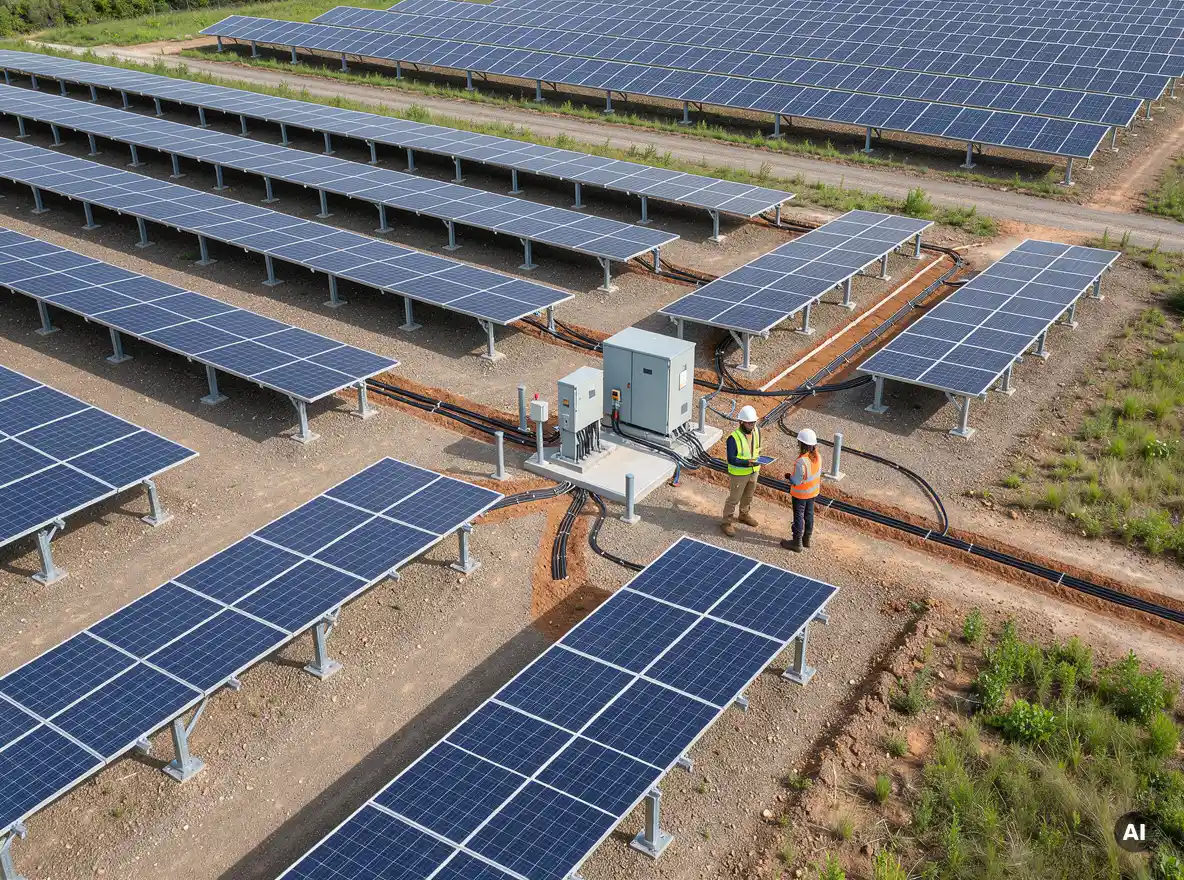

Inverter sizing and string limits set the electrical boundaries inside which every solar panel layout design must fit. The inverter’s DC/AC ratio caps how many modules an array can carry, while the string voltage window decides how those modules are grouped and where they can physically sit on the roof or field.
In practice, layout and electrical sizing are one problem, not two. Treat them separately and you will redo work later. Below, we answer the key questions engineers ask when the two meet.
How does the DC/AC ratio determine array size?
The DC/AC ratio compares the total DC module capacity to the inverter’s AC output rating. Since the inverter defines the AC ceiling, the chosen ratio sets how many modules the array can hold. A 1,000 kW AC inverter at a 1.25 ratio supports roughly 1,250 kWp of modules.
Most C&I and utility designs oversize the DC side on purpose. Modules rarely produce nameplate power, so a ratio above 1.0 keeps the inverter working closer to its rated output across more hours of the day. The trade-off is clipping: at peak irradiance the inverter caps production and the surplus is lost.
The right ratio depends on several factors:
- Climate and irradiance: sunnier sites usually tolerate less oversizing before clipping losses outweigh the gains.
- Tilt and orientation: east-west layouts flatten the production curve and often support higher ratios.
- Grid export limits: a capped connection point can justify more DC capacity behind a fixed AC limit.
- Economics: extra modules cost less than extra inverter capacity, which is why oversizing is so common.
Once you know the target DC capacity, divide it by the module wattage to get the module count. That number then feeds directly into string design.
What string limits control how many modules fit per string?
String length is limited by the inverter’s MPPT voltage window and its maximum DC input voltage. The shortest string must stay above the minimum MPPT voltage in hot conditions, and the longest must stay below the maximum system voltage at the coldest expected temperature.
To find those limits, engineers work with module temperature coefficients and site temperature extremes:
- Calculate the module’s open-circuit voltage at the lowest recorded site temperature. This gives the maximum string length.
- Calculate the module’s maximum power voltage at the highest expected cell temperature. This gives the minimum string length.
- Check the string’s current against the MPPT input current limit, especially when parallel strings share one input.
Any change to module specifications shifts these numbers. A new module with a higher open-circuit voltage can shorten the allowed string by a full module, and that ripples into every downstream calculation.
How do string limits shape module placement on the layout?
String limits shape module placement because each string should occupy a continuous, logical block of the array. The number of modules per string dictates table size, row length, and how rooftop zones or ground-mount blocks are divided. A layout that ignores string length leaves awkward leftovers.
Think of a roof section that fits 47 modules when your string length is 20. You get two full strings and seven stranded modules. Engineers then either drop those modules, redesign the zone, or accept a mismatched string that hurts performance. On ground-mount sites, the same logic drives table dimensions and block boundaries.
Good solar panel layout design groups modules by shared orientation, tilt, and shading profile, so each string sees uniform conditions. Mixing shaded and unshaded modules in one string drags the whole string down to its weakest member. Routing also matters: strings that end close to the inverter or combiner box save cable and reduce voltage drop.
Which inverter type works best for a given layout?
String inverters suit most rooftop and mid-size layouts, central inverters fit large uniform utility-scale blocks, and microinverters or optimizers help on complex roofs with heavy shading. The best choice follows from the layout’s geometry, scale, and shading profile.
String inverters
These work well on commercial rooftops with several orientations, since each MPPT input can handle a different roof plane. They offer flexibility and easier maintenance, and they scale cleanly across large flat sites too.
Central inverters
These make sense for large, uniform ground-mount plants where thousands of modules share the same orientation and conditions. Fewer units simplify the AC side, but string and combiner design must be precise because one inverter carries a lot of capacity.
Module-level power electronics are a third route when shading or irregular roofs make uniform strings impossible, though they add cost and components. Match the inverter to the layout’s uniformity: the more uniform the field, the more a larger inverter pays off.
What happens when string or inverter sizing is wrong?
Wrong sizing causes lost energy, equipment stress, or outright shutdowns. Strings that are too long can exceed the inverter’s maximum voltage on cold mornings, risking damage. Strings that are too short can fall below the MPPT window on hot days, so the inverter stops producing.
Other consequences show up in different ways:
- Excessive clipping: an overly high DC/AC ratio wastes production at peak hours.
- Underused inverters: a ratio that is too low leaves expensive AC capacity idle.
- Mismatch losses: strings with unequal module counts or mixed conditions underperform.
- Late-stage rework: errors found at commissioning mean redrawn layouts, new cable runs, and delayed handover.
The costliest part is timing. A voltage error caught in design costs minutes to fix. The same error caught on site costs weeks.
How can engineers keep layouts and sizing in sync?
Engineers keep layouts and sizing in sync by linking module placement directly to electrical calculations, so a change in one updates the other. Working from a single source of truth beats juggling spreadsheets and separate CAD drawings, where every revision means recalculating by hand.
A few habits help regardless of your toolset:
- Fix the inverter model and string limits early, before detailed placement begins.
- Validate string voltages against site temperature extremes every time the module changes.
- Design in blocks that match string length so no modules are stranded.
- Re-check the DC/AC ratio after every layout revision, not just at the start.
This is where we built Virto.CAD to help. It runs inside AutoCAD and BricsCAD, automates string planning, and keeps module layouts tied to inverter and string calculations, so revisions flow through without starting over. In one documented project in Belgium, it cut design time by 80%. If you want to see how it fits your own workflow, get in touch with our team and we will walk you through it.
Frequently Asked Questions
Where should I start when sizing an inverter and strings for a new project?
Begin with the site’s temperature extremes, the module datasheet (Voc, Vmp, temperature coefficients), and a shortlist of inverter models with their MPPT voltage windows and current limits. Then pick a target DC/AC ratio, calculate minimum and maximum string length, and only after that start placing modules. Fixing these electrical boundaries first prevents redoing the layout when a string turns out to be too long or too short.
What DC/AC ratio should I use as a starting point?
Many Cu0026I and utility designs start between 1.15 and 1.35, then refine based on the site. Use a lower ratio in high-irradiance, optimally tilted installations where clipping is more likely, and a higher one for east-west layouts or sites with a grid export cap. Run a simulation in a tool like PVsyst or your design software to compare the extra energy gained against clipping losses before committing.
What should I do if my roof section doesn't divide evenly into full strings?
First, check whether a different string length within the allowed voltage window lets the module count divide evenly. If not, consider shifting zone boundaries, moving a few modules to an adjacent area with the same orientation and shading, or using an inverter with multiple MPPT inputs so a shorter string sits on its own input. Avoid mixing a short string with a longer one on the same MPPT input, since the mismatch will cost you production.
Can I connect strings of different lengths or orientations to the same MPPT input?
It is best avoided. Strings on one MPPT input operate at a shared voltage, so unequal lengths or different orientations force some modules away from their maximum power point. If you must combine them, use an inverter with independent MPPT inputs for each roof plane, or consider module-level power electronics for the problem areas.
How often should I re-validate string voltages during design?
Every time the module model, inverter model, or site temperature data changes, and again after any major layout revision. A small change in module Voc can remove a module from the maximum string length. Build re-checks into your design checklist, or use software that recalculates automatically so nothing slips through to commissioning.
How do I check that string current won't exceed the inverter's MPPT input limit?
Compare the module’s short-circuit current (Isc), with any required safety factor, multiplied by the number of parallel strings on the input, against the inverter’s maximum input current rating. Also confirm the Isc per input does not exceed the inverter’s short-circuit current limit. If you are close to the limit, reduce parallel strings per input or choose an inverter with higher-current MPPT inputs.
What are the most common mistakes engineers make when combining layout and electrical sizing?
The most frequent ones are using the wrong temperature extremes for voltage calculations, placing modules before fixing string length, mixing shaded and unshaded modules in one string, and forgetting to re-check the DC/AC ratio after layout changes. Another common issue is relying on separate spreadsheets and drawings that fall out of sync. Locking in inverter and string limits early and linking placement to calculations avoids most of these problems.